
ClassSight XR
THE QUESTION
Can an AI-powered, bilingual platform improve the confidence, classroom delivery, and professional development of teachers transitioning to English instruction?
LOCATION: Ethiopia
SECTOR: Education
TECH: Artificial Intelligence
TIMELINE: 2025 - Present
PIONEERS: Chris Berry & Sewit Getachew
PARTNERS: Guzo Technologies
The Challenge
Ethiopia's national policy requires all secondary school teaching to shift to English as the medium of instruction from Grade 7 onward. While this policy aims to improve student outcomes and global competitiveness, many teachers lack the confidence, proficiency, and pedagogical support to teach effectively in English. Existing teacher professional development (TPD) programmes are typically short, in-person workshops with a ToT methodology that provide no continuous feedback or structured practice opportunities.
The challenge is particularly acute in rural schools in remote areas, where resource constraints, including low connectivity, low-spec devices, and limited access to sustained training further exacerbate inequalities. Without scalable, accessible, and context-relevant tools and job aids, and with limited ability to practice and get appropriate feedback on their spoken English for teaching, teachers struggle to deliver lessons clearly and confidently in English, ultimately impacting the quality of learning for millions of students.
The Idea
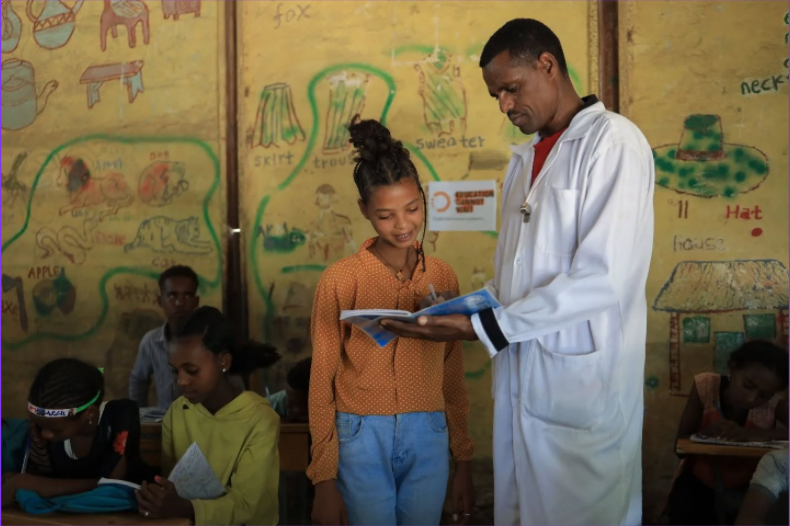
ClassSightXR is a mobile-first, offline-capable application that helps Grade 7 and 8 teachers in Ethiopia practise classroom English through short, guided lessons. Using AI speech analysis, the app provides instant feedback on pronunciation, pace, clarity, and teaching method, delivered in Amharic or Afaan Oromo so that teachers fully understand the guidance. Unlike generic English-learning apps, ClassSightXR is purpose-built for Ethiopian teaching contexts, aligned with Ethiopia's TPD and curriculum frameworks, recognising Ethiopian-accented English, and designed to run on low-spec smartphones, making it both practical and scalable.
The immediate frontier technology is AI, providing real-time, bilingual feedback that directly addresses the gap in continuous, personalised coaching. Extended Reality (XR) forms part of the longer-term vision: as devices and infrastructure improve, the platform will extend into more immersive classroom simulations. This phased approach ensures practicality now while positioning Ethiopia at the forefront of frontier EdTech adoption as capacity grows.
What We’ve Learned
A pilot with 87 Grade 7 and 8 teachers across 4 schools generated evidence across five key areas:
Adoption and use: Teachers showed consistent engagement for lesson preparation and reflection. Bilingual feedback was a key motivator, as was the potential for CPD recognition. Barriers included limited smartphone access and time constraints. Adoption is strongest when the tool is positioned as practical daily support rather than an additional task.
Effectiveness of AI feedback: Teachers reported that receiving feedback in Amharic and Afaan Oromo made guidance clearer, more actionable, and less intimidating. Several demonstrated measurable improvement in pronunciation, clarity, and delivery when applying AI suggestions in subsequent lessons. Personalised, bilingual AI feedback is a critical enabler of adoption and effectiveness, particularly in schools where English proficiency is lower.
AI support for pedagogy and classroom practice: The pilot showed that AI can capture elements of teaching delivery such as clarity, pacing, and engagement, not only pronunciation. Subject-specific practice scenarios covering English, Science, and Citizenship Education helped link language improvement to actual classroom instruction. For meaningful classroom impact, the platform must combine language support with pedagogical coaching.
Accessibility and usability: The app functioned without continuous internet access and synced data successfully when connectivity was restored. It worked well on mid-range and most low-spec smartphones, though very low-memory devices posed challenges. An offline-first, mobile-first design is essential in rural and semi-urban Ethiopia, and future scale will require continued optimisation for older devices and simplification of the interface.
Scalability and system fit: The Ministry of Education expressed strong interest in further aligning ClassSightXR with the national CPD/TPD framework and running a pilot. Barriers include limited smartphone penetration in some rural areas, a need for ongoing training support, and forex challenges in procurement particularly for servers and other digital running costs. For ClassSightXR to scale, it needs to be integrated into existing CPD structures, supported by Ministry of Education endorsement and co-ownership, and designed to remain affordable and accessible in low-resource contexts.
What Happens Next
Building on the pilot findings, the next phase focuses on three main priorities: co-designing the value proposition and integration pathway with the Ministry of Education and the proof points required from a pilot with the Ministry; exploring additional opportunities for ensuring digital inclusion such as AI-enabled interactive voice response (IVR) options for teachers with feature phones and those with vision disabilities; and developing a proposed business and financial model for scaling through the public sector that can be tested with the Ministry of Education in order to embed sustainability into the design process.
ADDITIONAL RESOURCES:
Prior to the pilot with Guzo Technologies, the FT Hub as part of the country immersion pilot workstream conducted a deep dive into the critical challenge in Ethiopia around teacher professional development, and the opportunities for frontier tech intervention to mitigate those challenges. The results from this exploration were validated with a multidisciplinary group of stakeholders in Ethiopia, representing government, international development and humanitarian agencies, civil society actors and education sector innovators. The research was foundational to the approach to identifying use cases for frontier tech intervention to support TPD in Ethiopia and the subsequent call for tech expertise to respond to the challenges identified and validated by key stakeholders.
Our learnings and stories so far
This pilot hasn’t started to publish yet, but there are plenty of other blogs to read below. Check back soon!








The Hub's funding and proof of concept now allows us to unlock reshoring and localised manufacturing for organisations and companies of unlimited size.