AI Early-Warning Systems to detect Forest Fires
A blog by the Frontier Tech Hub
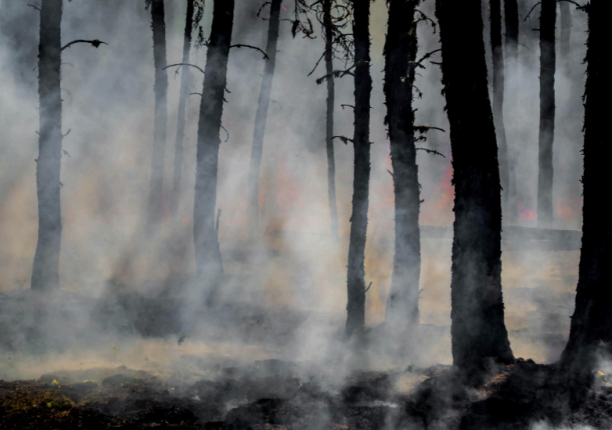
Forest fires are becoming more frequent and destructive across Pakistan, driven by rising temperatures, prolonged droughts, and land-use pressures. Between 2001 and 2019, the country recorded nearly 18,000 forest fire incidents, disproportionately affecting the forest-dependent communities who tend to be poorer, as well as fragile ecosystems. Existing fire management approaches remain largely reactive, relying on visible detection and risky, manual firefighting methods often undertaken by local communities themselves. This pilot explored whether an AI-enabled early warning system could enable earlier detection and support safer, more coordinated forest fire response.
Led by Lahore University of Management Sciences (LUMS) and WWF-Pakistan with support from the Frontier Tech Hub, the initial pilot tested whether a low-cost, integrated technology stack could work in real forest conditions. The system combined AI-enabled pan-tilt-zoom cameras, IoT sensors, weather stations, satellite data, and machine-learning models into a single dashboard used by the Khyber Pakhtunkhwa (KP) Forest Department. The ambition was not only to detect fires earlier, but also to predict where fires were most likely to occur and how they might spread. In short, the pilot aimed to supporting forest fire mitigation, preparedness, and response, rather than firefighting alone.
Three core questions guided the original pilot:
First, could the underlying hardware and software operate reliably in remote, mountainous environments with limited connectivity and power?
Second, could machine-learning models be trained to detect fire, predict hotspots, and model fire spread despite limited local datasets?
Third, what role would communities and forest departments need to play for such a system to be trusted, adopted, and used in practice?
Field deployments in Mansehra District showed that the core technology worked as intended, with cameras, sensors, and dashboards functioning in real-world conditions and providing actionable information to forest officials.
The pilot also surfaced critical non-technical insights. Community engagement proved essential for raising awareness about the causes and dangers of forest fires; many of which were found to be human-caused. While AI could detect fires, effective response still depended on people: trained staff, safer firefighting practices, and clear protocols for what happens once an alert is raised. These findings highlighted that early warning systems must be embedded within broader fire management and community preparedness strategies to deliver real impact.
Building on this foundation, the follow-on fund phase focused on the longer-term scalability, and operational readiness. The team expanded deployments to additional sites and tested off-grid, solar-powered towers, demonstrating that solar energy is more reliable than grid power in remote areas. They also explored alternative connectivity solutions, including long-range Wi-Fi, to overcome weak GSM coverage. This showed that high-bandwidth monitoring is feasible even in challenging terrain with the right design choices.
The follow-on work further strengthened the system’s intelligence. The AI module was adapted to different geographies and vegetation types, successfully detecting real fire incidents and reducing false positives through improved image filtering. New features showed promise in helping forest departments plan safer and more effective response routes during fire events. Importantly, provincial government stakeholders began budgeting for system maintenance and engaging with the technology as an operational tool rather than a standalone pilot - an early signal of institutional uptake.
Taken together, the two reports demonstrate that AI-enabled forest fire early warning systems are technically feasible, operationally valuable, and increasingly scalable in Pakistan. However, they also underline that technology alone is not enough. Long-term impact depends on reliable power and connectivity, local data to refine predictive models, sustained government ownership, and meaningful engagement with communities who are both affected by and involved in fire response. For countries facing intensifying climate risks, this work offers a practical blueprint for how frontier technologies can support earlier action. It is grounded in a realistic approach, incorporating local realities and public sector capacity.
To read the pilot report and follow-on-fund report, click below:
If you’d like to dig in further…
Date published: 16th December 2025