

Beyond the Hype
Nine Underhyped Frontier Technologies
for International Development
Amidst the buzz of AI, truly game-changing technologies are being overlooked.
The Frontier Tech Hub has been scanning the horizon for the breakthroughs hiding in plain sight—the innovations that could make a real difference but rarely make headlines.
The nine technologies below hold real potential to shape a more sustainable, resilient future in the face of a rapidly changing development landscape and the relentless threats of climate change. They’re the complex, unsexy solutions that can power off-grid communities, optimise water cycles and speed up the shift to renewables.
It’s time to turn our attention away from the traditional hype cycle and bring these technologies into the spotlight. Because the real frontier isn’t about what’s trending—it’s about what can quietly, sustainably transform lives.


Are you ready to discover the Nine Underhyped Frontier Technologies?*
*Click on the dots below to explore
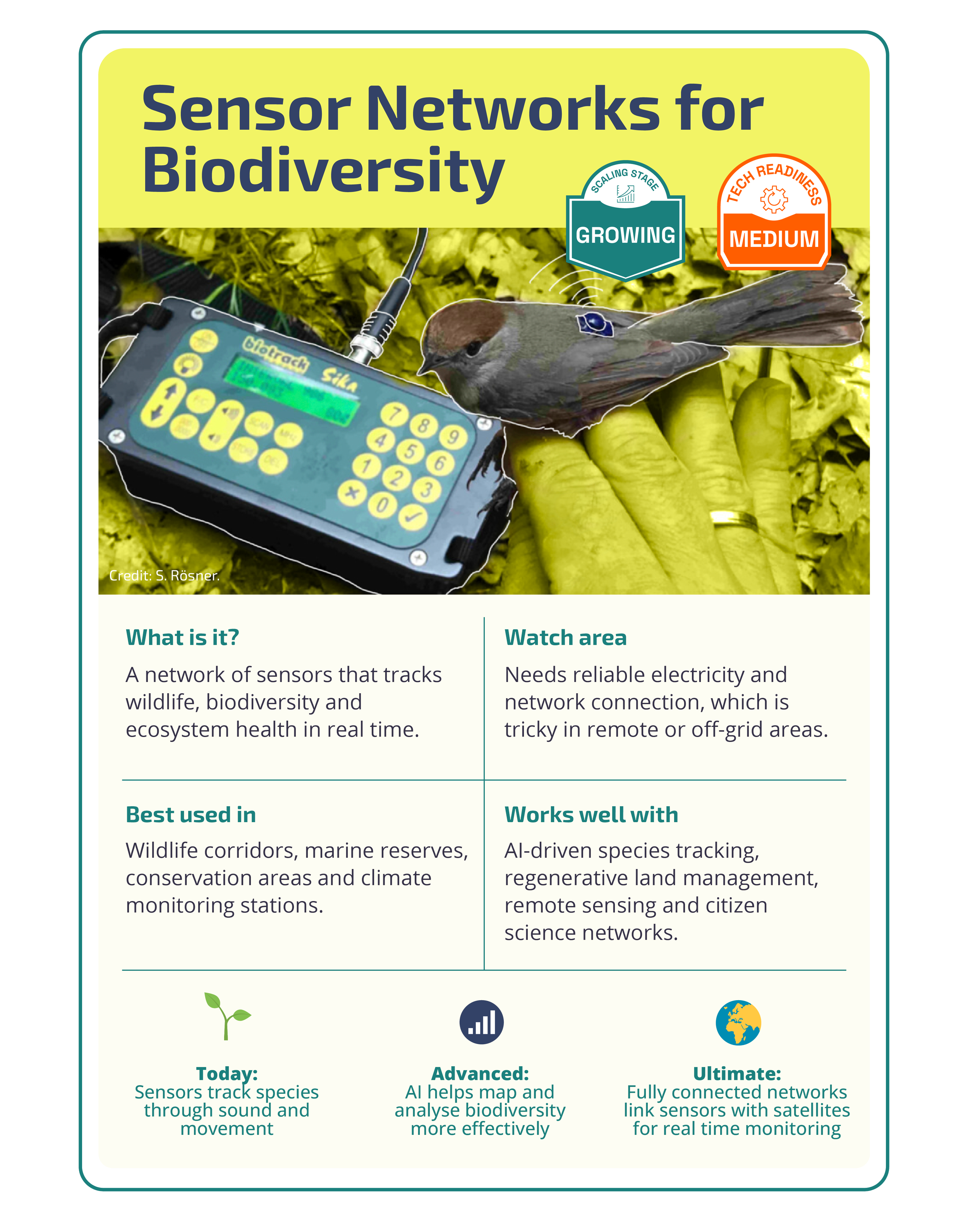
Sensor Networks for Biodiversity


What is it?
A network of sensors that tracks wildlife, biodiversity and ecosystem health in real time, helping conservation efforts stay ahead of changes.
Watch Area
Needs reliable electricity and network connection, which is tricky in remote or off-grid areas.
Best used in
Wildlife corridors, marine reserves, conservation areas and climate monitoring stations.
Works Well With
AI-driven species tracking, remote sensing, regenerative land management, and citizen science networks.

Today:
Sensors track species through sound and movement

Tomorrow:
AI helps map and analyse biodiversity more effectively.
Beyond:
Fully connected networks link sensors with satellites for real time monitoring.
Water Management Networks

What is it?
A system to predict water access and quality, helping communities build resilience against droughts, floods, and pollution.
Watch Area
Needs significant investment in tech and connectivity, plus policy support to integrate fully into existing infrastructure.
Best used in
River basins, areas vulnerable to floods or drought, urban and rural water systems, and shared water governance.
Works Well With
Regenerative water cycles, decentralised rainwater harvesting, smart irrigation and community-led water monitoring.
Today:
Basic sensors detect leaks and measure water quality.
Tomorrow:
Connected networks manage whole watersheds.
Beyond:
Fully connected networks link sensors with satellites for real time monitoring.
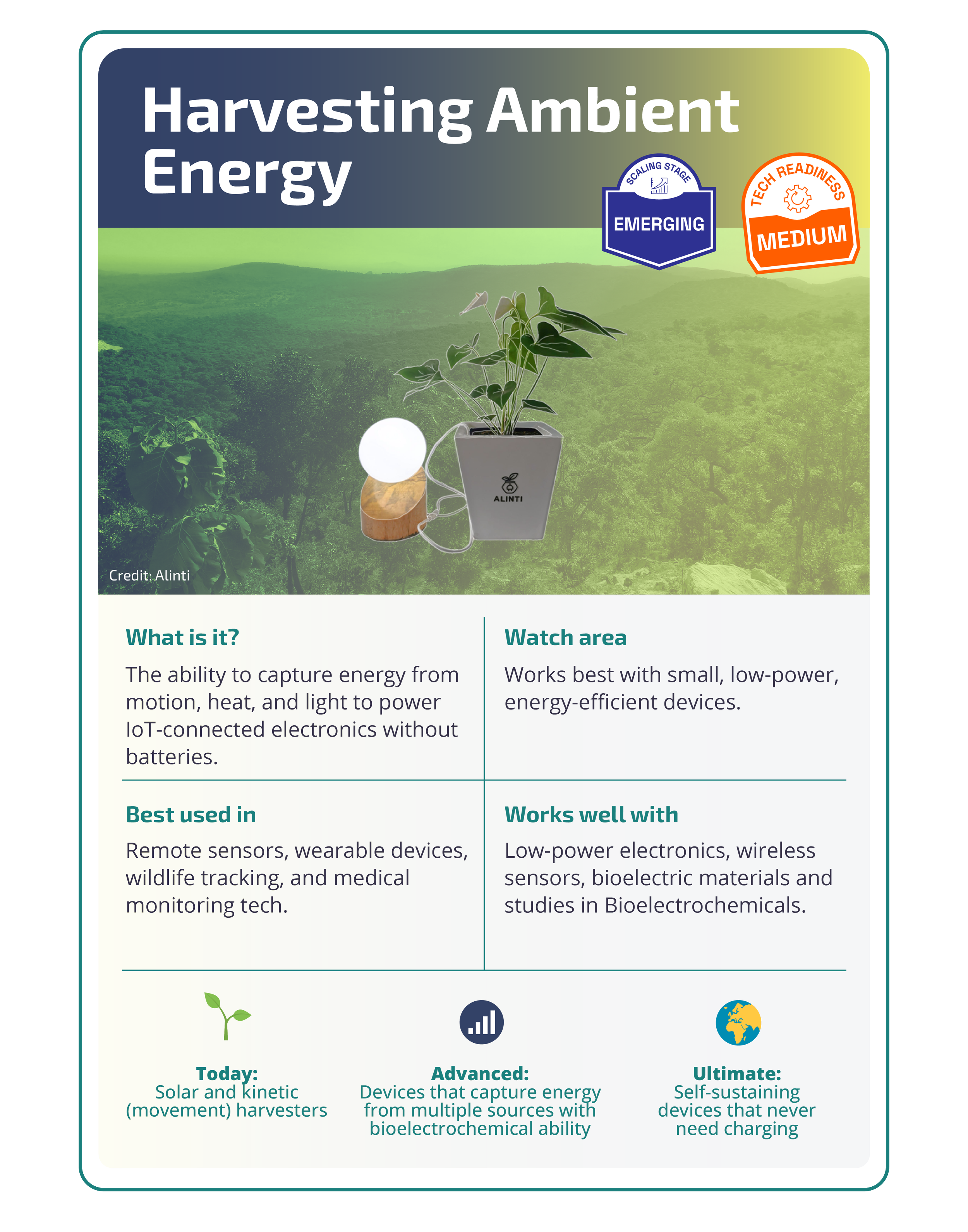
Harvesting Ambient Energy


What is it?
The ability to capture energy from motion, heat, and light to power IoT-connected electronics without batteries.
Watch Area
Works best with small, low-power, energy-efficient devices.
Best used in
Remote sensors, wearable devices, wildlife tracking, and medical monitoring tech..
Works Well With
Low-power electronics, wireless sensors, bioelectric materials and studies in Bioelectrochemicals.
Today:
Solar and kinetic (movement) harvesters.
Tomorrow:
Devices that capture energy from multiple sources with bioelectrochemical ability.
Beyond:
Self-sustaining devices that never need charging.
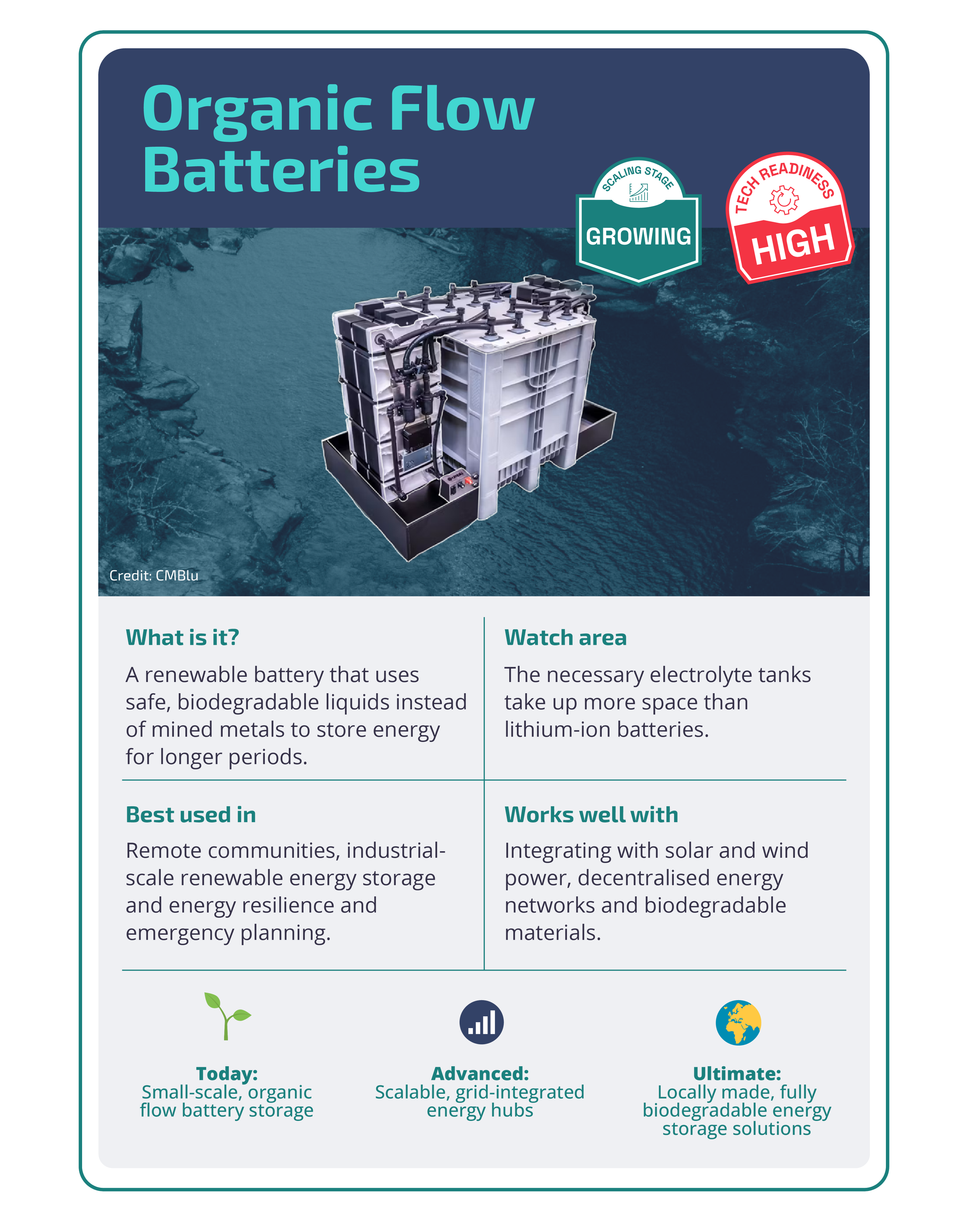
Organic Flow Batteries

What is it?
A renewable battery that uses safe, biodegradable liquids instead of mined metals to store energy for longer periods.
Watch Area
The necessary electrolyte tanks take up more space than lithium-ion batteries.
Best used in
Remote communities, industrial-scale renewable energy storage and energy resilience and emergency planning.
Works Well With
Integrating with solar and wind power, decentralised energy networks and biodegradable materials.
Today:
Small-scale, organic flow battery storage.
Tomorrow:
Scalable, grid-integrated energy hubs.
Beyond:
Locally made, fully biodegradable energy storage solutions
Thermal Energy Storage

What is it?
A way to store and reuse heat for cooking, heating, and refrigeration without relying on batteries.
Watch Area
Some systems require bulky materials, making it harder to build in urban areas.
Best used in
Off-grid communities, solar cooking, cold storage and passive heating.
Works Well With
Solar heating, phase-change materials, sustainable construction and food security.
Today:
Rock beds, solar dryers and cookers.
Tomorrow:
Cold storage using phase-change materials.
Beyond:
Sand batteries and community-scale heat storage.
Waste-Powered Energy

What is it?
A system that turns organic waste into biogas and electricity, improving sanitation while reducing pollution.
Watch Area
The social stigma around using human waste will likely slow adoption and investment.
Best used in
Off-grid villages, refugee camps and farms managing large amounts of waste.
Works Well With
Circular economies, decentralised energy grids, sanitation and public health initiatives.
Today:
Small biogas digesters for the home.
Tomorrow:
Using microbial fuel cells that generate electricity.
Beyond:
Sanitation systems that turn waste into power and agricultural biofertilisers.
Bioremediation


What is it?
Using microbes, fungi, and plants to clean up polluted environments and rebuild healthy ecosystems.
Watch Area
Bioremediation works at nature’s pace, so results take longer than chemical methods.
Best used in
Old industrial sites, mining zones, farms polluted with pesticides and oil spills.
Works Well With
Agroecology, community-led restoration, and environmental justice initiatives.
Today:
Plants help absorb toxins from soil.
Tomorrow:
Fungi and bacteria speed up cleanup.
Beyond:
AI-enhanced biosensors create super-efficiencies.
Algal Photobioreactors

What is it?
An enclosed system that grows algae at scale. Algae can capture CO₂, produce biofuels, and clean wastewater.
Watch Area
Algae cultivation needs precise conditions and delicate management to thrive.
Best used in
Carbon capture projects, renewable energy farms, wastewater treatment, and climate resilience initiatives.
Works Well With
Circular bioeconomy, sustainable farming and aquaculture, and the voluntary carbon market.
Today:
Open ponds grow algae for fuel.
Tomorrow:
Enclosed photobioreactors use optimised strains of algae.
Beyond:
AI-monitored algae systems integrated into cities and industries.
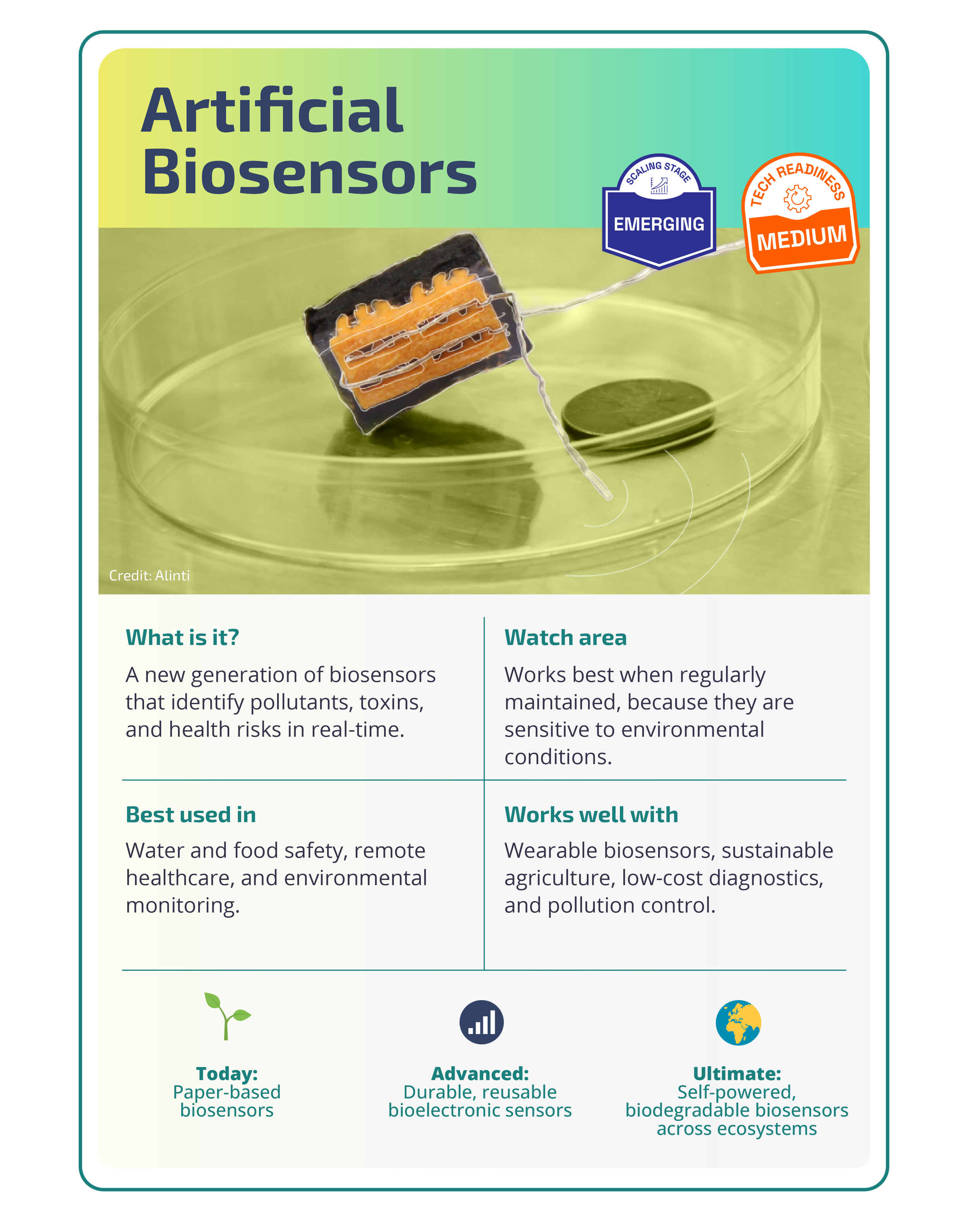
Artificial Biosensors

What is it?
A new generation of biosensors that identify pollutants, toxins, and health risks in real-time.
Watch Area
Works best when regularly maintained, because they are sensitive to environmental conditions.
Best used in
Water and food safety, remote healthcare, and environmental monitoring.
Works Well With
Wearable biosensors, sustainable agriculture, low-cost diagnostics, and pollution control.
Today:
Paper-based biosensors.
Tomorrow:
Durable, reusable bioelectronic sensors.
Beyond:
Self-powered, biodegradable biosensors across ecosystems.
Scroll through all nine technologies and click through to learn more





What does it mean to be “Underhyped”?
We can assess tech hype by comparing two things: attention (how much buzz a technology gets—like news, patents, or research) and potential (how well it could support development goals, such as economic, social, or environmental impact).
“Underhyped Frontier Technologies” possess significant capacity to address locally defined priorities (potential) yet do not receive attention due to dominant narratives that prioritise top-down, market-driven solutions.

-
When assessing tech hype, things get complicated quickly.
Who decides what gets used? Whose problems are being solved? Where is it applied, and who benefits? These questions highlight the blind spots in traditional development models.
To move forward in a complex, connected world, we need new perspectives—ones that respect local voices, diverse knowledge, and the planet’s limits. Some areas have seen great progress; others have been left behind. That gap affects us all.
To explore underhyped frontier technologies in development, we need to rethink what attention and potential mean. This helps shift the focus from flashy trends to locally driven and truly impactful solutions—ones often missed by mainstream frameworks.
-
The attention a technology can capture shouldn’t just be defined in terms of the majority or the most powerful. That is why the question of ‘who’ becomes fundamental. Who is the technology important for? Who is paying attention to it? Who will pay for it? Who benefits from it?
That is why we consider that a better-suited form of attention should focus on the underserved. That is, the voices that do not represent those in traditional decision-making positions, or, in other words, those that truly benefit or suffer from new technologies being implemented. In many cases, this refers to local communities, as they know best what their needs are and how a particular technology can impact them.
In that sense, attention can be reformulated as:
“The degree to which a technology receives recognition and validation across diverse stakeholders and knowledge systems. It should consider a particular emphasis on communities, especially those it aims to serve.”
Such a view should point to narratives that consider different points of view, not just the traditional or the mainstream ones. This means giving a voice to local knowledge, just as it means understanding local contexts.
-
Commonly thought of as a technology’s ability to address development goals effectively, this definition falls short in the same way that development falls short. Some of its main critiques are that there should be greater consideration of locally defined priorities, contributing to plural visions of well-being, all while respecting ecological boundaries to truly create long-term sustainable impact.
Thus, we can think of the following definition of potential:
“A technology's capacity to create long-term systemic impact while responding to local needs. It should challenge the narrative about the ‘right’ way to do things.”
By adopting this perspective, thinking in terms of a technology’s potential becomes a way to bring closer communities and real-world solutions that address local needs.
-
“Frontier technology” refers to new, emerging capabilities like machine learning, drones, blockchain and the internet of things. But it’s also a term we use for established technologies when they’re being used in ways they haven’t been tried out before.
A frontier technology may not yet be fully mature, making it hard to predict how it will evolve. Some will be in the early application stage while others might already be mature in existing markets, offering offer new applications elsewhere.
They may also challenge conventional business models, requiring alternative approaches to scalability, ownership, and governance. To reach their full potential they may need to explore matters related to monetisation and adaptability.


Recommendations
Through a series of recommendations, we aim to support policymakers and regulators; funders and investors; technology implementers and practitioners.
These 5 recommendations offer: a long-term perspective for frameworks that safeguard technological sovereignty and prevent monopolisation; concrete actions to ensure ethical adoption, security, and community empowerment; and guidance on participatory and regenerative technology design.
How do you measure hype?
Taking a list of 142 technologies to just 9 demands a multi-disciplinary approach.
Find out how we designed a “hype” scorecard, assessed scaleability using foresight methods and convened a Global Brain Trust of experts and community representatives to provide ethical, cultural, and practical insights.
Our methodology supported a final list of technologies prioritising accessibility, autonomy, scalability, social justice, and ecological balance.


What does the future hold?
As the world constantly changes, it's tough to predict which technologies will shape our lives a decade from now, and even harder to imagine how they will do so.
Foresight is a systematic way to look into the future that can help anticipate challenges and opportunities. We used this method to consider possible futures for the nine underhyped technologies.
A huge thanks to our Global Brain Trust, without whom this work would not have been possible

“Given the pace of technological change and the increasingly complex contexts in which we’re working it’s vitally important for FCDO staff to be able to continue to harness technologies to achieve development goals.”
The team behind this project
-

Miguel Bello
FOUNDER
-

Dr. Becky Faith
FCDO
-

Mauricio Franco
Pluriversa
-

Ricardo Lapeira
Pluriversa
-

Daniela Montenegro
Pluriversa
-

Bryony Nicholson
Brink
-

Lil Patuck
Brink
-

Asad Rahman
Brink
-

Juan Sebastián Sánchez
Pluriversa
Hold on though, because this isn’t the first Top Tech List the Hub has published…
Over the past decade, the Frontier Tech Hub has been on the cutting edge of emerging tech uses for development and diplomacy, supported by key moments of evidence-driven curiosity.
Ten years ago, the Hub was set up to respond to a milestone piece of research into Ten Frontier Technologies for International Development, to test and learn about them in the real world.
Five years later, we surfaced and published the Top Ten Frontier Technologies for Climate Action, calling for Pioneers to build out our collective learnings around their use.
Since 2016, we have tested 91 solutions across 30 countries, building an expanding portfolio to put each of these critical moments of insight to the test in lean, agile ways, reflected in the timeline below.
And now, we’re publishing this third list with the next Frontier: the Nine Underhyped Frontier Technologies for International Development.

