Turning Banana Waste into a Solution for Yam Loss
A blog by Harry Sharp and Alex Bailey, Frontier Tech Hub Coaches, and Ezekiel Hayford, FCDO Pioneer, based on reports by the University of Ghana and the Council for Scientific and Industrial Research - Savannah Agricultural Research Institute
Discovery: Protecting white yam crops using treated banana-fibre paper
Yams are central to food security and rural livelihoods in northern Ghana. But they are also vulnerable. Farmers described heavy losses from pests and diseases, especially during storage, when tubers that appear healthy on the outside can crack open to reveal rot, cavities and discoloured flesh.
The University of Ghana’s scoping study quantified this problem: over 30% of yam tubers are lost to nematodes after harvest, and in some communities long-term storage losses reach 50%. The most damaging culprits are plant-parasitic nematodes such as Scutellonema bradys and Meloidogyne spp., which cause dry rot and significantly reduce market value. For farmers whose livelihoods depend on yam cultivation, these losses are significant.
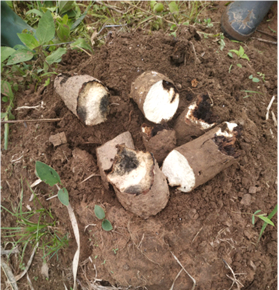
Harvested yams showing signs of dry rot
The Frontier Tech Hub set out to explore whether a simple, nature-based technology, banana-fibre paper treated with abamectin, could offer a feasible alternative to current practices. The wrap serves both as a physical barrier and a delivery mechanism for nematicide. The idea has a circular logic to it: transforming waste banana stems into a potential on-farm solution. Previous trials cited in the University of Ghana (UoG) report showed promising results: more than 85% reduction in dry rot, over 20% improvement in yield, and a possible 2:1 return on investment. But little was known about whether the solution could work in practice in Ghana, who would use it, who would manufacture it, and what it would take to bring it to market.
To answer these questions, the Hub supported two phases of early-stage discovery: a three-month scoping study led by UoG (Phase 1), followed by a six-week commercial feasibility study led by CSIR–SARI (Phase 2). Together, they provide insight and evidence into the potential, and the challenges, of this innovation.
Phase 1 (3 months): Understanding farmer realities and system constraints
Fieldwork in Zabzugu and Yendi involved 62 farmers, 40 wholesalers, 40 consumers, and 10 input dealers, alongside interviews with cooperatives, extension agents, NGOs and regulators. Farmers had strong experience (an average of 17 years cultivating yams) and the majority recognised nematode damage. Across the board, they described the same pattern: significant losses in the field, worse losses in storage, and limited pest-management practices.
Many farmers relied on improvised or inconsistent chemical use, often Lamda or “Furabag”, based largely on hearsay. Extension support was also limited, and 67.7% of farmers did not belong to any farmer-based organisation, which restricted opportunities for training or coordinated behaviour change.
Awareness of banana-fibre paper was extremely low, but interest rose quickly once the idea was explained. Farmers liked that the material comes from banana waste and could be produced locally. But they were clear about what they needed before adopting it: visible proof through demonstration plots, clarity on cost, guidance on how to apply the wrap, and reassurance on safety, since the paper touches the seed yam directly.
Input dealers, while largely unfamiliar with nematode-specific solutions, echoed these conditions. Stocking unfamiliar products without predictable demand is risky, they said. But with proper training, promotional support and clarity on supply, many indicated they would be willing to retail the product.
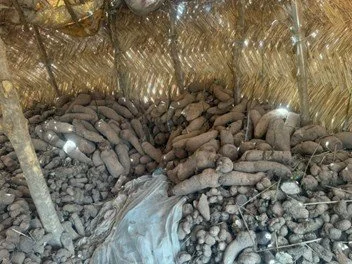
Yams in storage in a yam barn in Yendi, Ghana
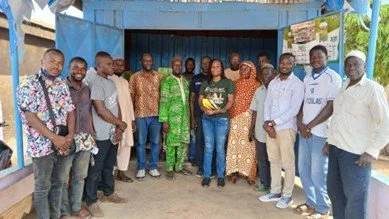
Engagement with Agri-Input Dealers in Zabzugu, Ghana
Regulators, including the Environmental Protection Agency (EPA), Ministry of Food and Agriculture (MoFA), Food and Drugs Authority (FDA) and Ghana Standards Authority (GSA), outlined the required pathway for registration: local efficacy trials, chemical and environmental documentation, and, where necessary, an Environmental Impact Assessment. This confirmed that the wrap would need to be tested in Ghana over at least two cropping seasons before approval.
Finally, the UoG report explored cost considerations. Early estimates suggested that local manufacturing could reduce production costs by up to 50%. Stakeholders also suggested that bundling the wrap with seed yam or distributing it through cooperatives or agro-dealers could be viable pathways for uptake.
Phase 2 (6 weeks): Engaging the private sector
CSIR–SARI’s second-phase work examined private-sector interest, manufacturing possibilities, and cost feasibility. The team met with agrochemical firms (such as Rainbow, Calli Ghana, Chemico, Dizzengorf, Solevo and Wynca), banana plantations (e.g. Golden Exotic Banana Company), seed companies, aggregators and researchers.

Engagement with private sector actors

Multi-stakeholder workshop with farmers, seed producers, aggregators, agro-dealers, and scientists
Several firms confirmed they could supply abamectin or abamectin-based products already registered in Ghana, including Orizon, Cymectine 2.0 EC and Sun-Abam. But none were willing to manufacture the banana-fibre wrap, viewing it as outside their core business. EU-linked firms noted that abamectin has been restricted in the EU since 2023, and although it is still registered in Ghana, this affected their desire to engage. Most companies said they would need evidence of farmer demand and a clear business case before committing.
CSIR–SARI also engaged Kudo Technologies, one of the few local firms with capability in fibre-based products, to explore whether it might serve as a manufacturing partner. Discussions explored Kudo’s capacity, equipment needs, and the technical feasibility of producing banana-fibre paper locally. While early-stage, CSIR–SARI’s assessment positioned Kudo as a realistic potential manufacturer, particularly given that agrochemical firms were unwilling to take on paper production.
CSIR–SARI also convened a multi-stakeholder workshop with farmers, seed producers, aggregators, agro-dealers, and scientists to assess economic viability and adoption potential. Participants were consistent: nematodes remain a major production constraint, any new technology must be effective, affordable, and not excessively labour-intensive, and awareness-raising through demonstrations and training would be essential.
Importantly, seed producers and some aggregators indicated they would be willing to pay up to twice the cost of current nematicide options if banana-fibre paper proved more effective. One aggregator proposed an input-credit model, with farmers paying 50% upfront and 50% at harvest, hinting at innovative financing pathways.
The EPA further clarified regulatory requirements during this phase. Registering the wrap would require formal field trials conducted across multiple yam-growing zones, using 0.25–0.5 acre plots per treatment arm, comparing the wrap with untreated seed and conventional nematicides. Trials would need to run for at least two seasons to satisfy regulatory evidence needs.
Where this leaves us
Taken together, the two discovery phases provide a clear and grounded picture of both the opportunity and the work still ahead. The scale of the problem is significant: nematodes consistently cause losses of 30–50%, affecting yields, storage, and farmer incomes. The banana-fibre paper concept shows strong technical potential, backed by earlier trials demonstrating an 85% reduction in rot, more than 20% yield gains, and a potential 2:1 return on investment. Across the value chain, stakeholders responded positively once the idea was explained. Farmers, input dealers, seed companies and aggregators all expressed interest, provided the wrap is affordable, available before planting, and supported by training and clear demonstrations.
The commercial and operational realities are more complex. While several firms are willing to supply abamectin or alternative nematicides, none are yet prepared to manufacture the wrap itself. Kudo Technologies, however, emerged as a credible local manufacturing prospect, particularly given the broader reluctance from agrochemical companies to take on fibre-based production.
Regulatory requirements are well defined and will require multi-season, multi-location trials to generate the EPA-compliant data needed for approval.
Cost modelling suggests that producing the wrap locally could halve manufacturing costs, which would be critical for meeting the price expectations farmers emphasised during Phase 1.
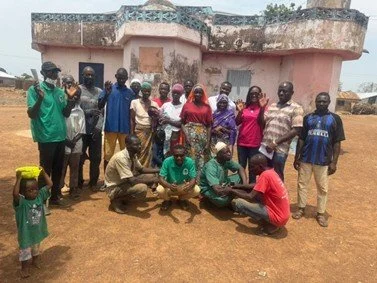
Engagement with yam consumers following focus group discussions in Yendi, Ghana
If the barriers can be addressed, the approach could offer Ghana a more sustainable and accessible way to protect yam crops. It has the potential to reduce losses, improve farmer incomes, and build new circular-economy value chains using banana waste.
The innovation also aligns closely with FCDO Ghana’s priorities: it strengthens food security by reducing crop loss, supports climate resilience through a biodegradable, waste-based input, and encourages inclusive economic growth by creating new roles for cooperatives, input dealers, and potential manufacturers. Beyond its technical benefits, it opens up space for meaningful private-sector participation and contributes to stronger rural livelihoods, which is the kind of innovation-driven, climate-smart solutions that FCDO aims to support.
To read the full reports from both discovery phases, click below:
Publishing date: 16/12/2025