A blog by Amy Nye introducing our latest learning brief on integrating AI and other technologies to improve access to justice for survivors in low-resource and post-conflict settings
Where AI stops and a human steps in
When our AI Legal Assistant pilot kicked off in Malawi in 2024, fewer than 50 legal aid lawyers were working through more than 25,000 active cases. It’s the kind of figure that nearly makes the case for AI on its own: Automate the research, speed up the drafting, triage the backlog, and suddenly, a stretched system has room to breathe. Across the Frontier Tech Hub's portfolio, we’re starting to see AI used in areas of justice for exactly that reason.
For this learning brief, we wanted to ask a harder question than "can AI help the justice system?", because we already know that is entirely possible. We wanted to know whether it's safe to let AI talk to a survivor directly, someone reporting gender-based violence, or preparing to testify about conflict-related sexual violence.
In the final document, you can explore our findings. We looked at five case studies and spoke to six people working across the field, including tech developers, funders, academics, and legal practitioners. This included an exploration of three FT pilots that have handled AI tools in order to increase access to justice.
In Malawi, an AI legal assistant piloted with the Legal Aid Bureau took aim squarely at the backlog. Automated legal research, drafting support, case triage, and predictive analytics to forecast how a case might go. Demand for it was strong across the judiciary, academia and civil society, and for good reason. This is AI doing what it's genuinely good at: relieving pressure on people who are already doing their best with too little capacity.
Head south to four districts in Malawi, Lilongwe, Blantyre, Zomba, Nsanje, and a GBV reporting service is at work. This service runs on USSD, the *123# style codes that work on the most basic handset, no app, no internet connection required. Most of the survivors this tool is built for don't own a smartphone, and many live with fear about who might see their phone or their search history. The AI takes a back seat here, powering a chatbot and a referral dashboard, while the interface stays as plain and unremarkable as possible.
At the International Criminal Court, a virtual reality (VR) prototype created by a Frontier Tech Hub pilot supports survivors of conflict-related sexual violence. They can step into a simulated courtroom, understand where they'd sit, what protective measures would shield them, before they ever had to walk into the real one. Survivors said it helped them feel the space in a way an explanation never could. The VR wasn't always better than a written script at conveying specific procedural detail, but it did something a script can't: it took some of the fear out of the unknown.
So what happens when AI does face a survivor directly?
Two tools outside our own portfolio show what that looks like in practice: a legal chatbot in Tanzania called Dada Wakili, and a crime-reporting platform called BackUp, piloted across Libya, Rwanda, Burundi, Guinea and now Nigeria. Both teams made the same deliberate choice. Dada Wakili's developers stripped the generative AI responses out entirely and replaced them with a human-built expert system, specifically because the tool reaches women with low literacy who might have no way of catching a wrong answer. BackUp uses AI to analyse crime data behind the scenes, but the questionnaire a survivor actually sees was written by a person.

One of the solutions explored (Dada Wakili) is now part of a new FT pilot: Justice in Her Pocket
Neither team was short on ambition or technical capability; the technology was not the limitation that made them stop short of full AI integration. Automation bias, the tendency to trust a confident-sounding answer over your own judgement, showed up again and again as a concern in our interviews. For a survivor asking about rights or reporting a crime, a wrong but confident answer could lead to serious harm.
The next part of the exploration
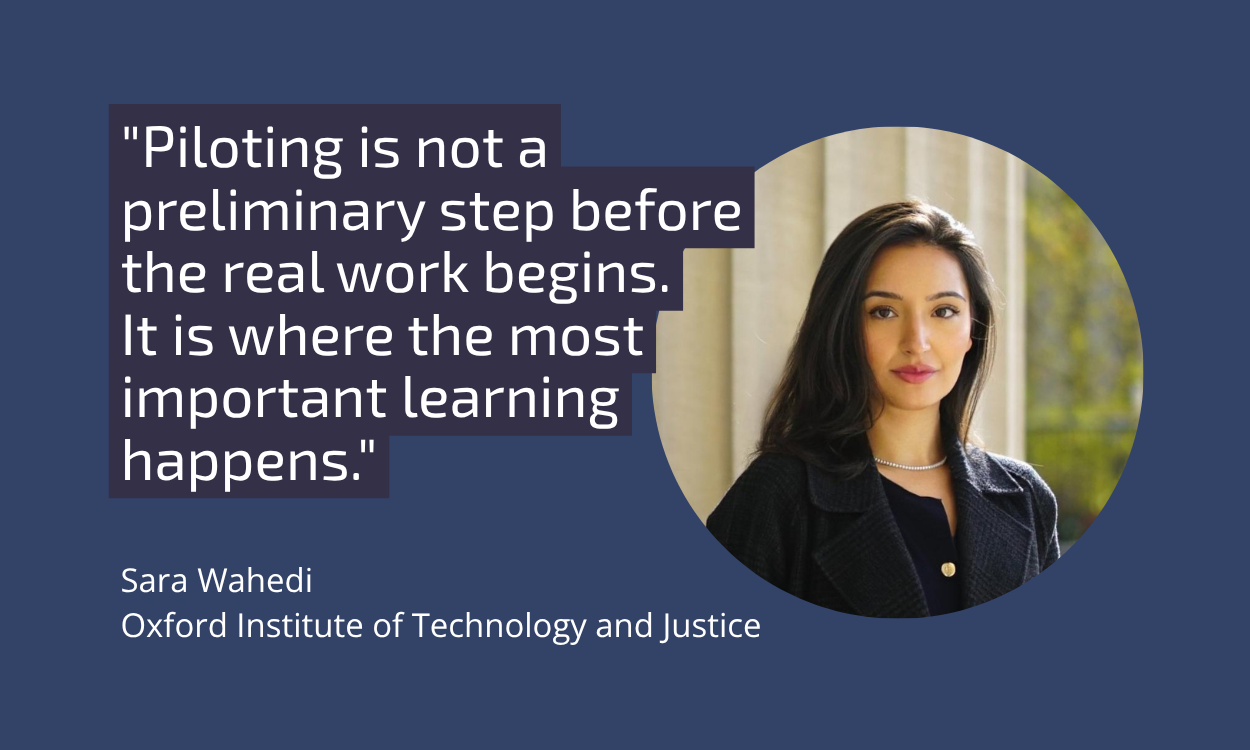
We came away from this research convinced that AI has proven value in easing pressure on overstretched justice systems, and promise in connecting survivors to referral pathways and support services. But we don’t have a confident answer to the extent to which an AI tool can safely interact with minimal human oversight, and whether that will ever be possible.
We’ve been speaking with organisations building and testing AI justice tools on the ground to sense-check what we found here against what's actually happening in practice.
Explore Frontier Tech pilots improving access to justice