A blog by Matt Weatherall, sharing signals from the future of international development in the age of AI.
This is the first of two blogs. Read part two here.
Ten years ago, much of the technology we tested was stuff you could pick up and drop on your toes. Today, much of what we see is AI + X, where AI is added to an existing tool, service, or way of working.
After ten years of testing frontier technologies, we’re looking ten years ahead. What might AI make newly possible for people doing development in the future?
Our early research points towards AI becoming part of systems that create new ways to decide, act, and learn. Whether these AI systems work in practice will depend on the human systems around them. So that’s the future we want to explore with you: what these systems could make possible, and what the sector could do now to shape how they arrive.
Why AI + X is getting easier
Across development, many uses of AI involve doing familiar work faster, more cheaply, or with less specialist effort. Here are four technical shifts that are making it easier to add AI to existing tools, services, and ways of working.
Foundation models give developers a head start
Foundation models provide a reusable starting point. Rather than building and training a model from scratch, developers can adapt one already trained on broad data. This can reduce the amount of task-specific data, training time, and computing power needed to create a new AI application. But the size of that head start depends on what the model already knows. For example, an FT Hub Pilot in Peru found that existing large language models (LLMs) performed poorly in Quechua and Aymara. Making them useful would require additional fine-tuning with more data in those languages.
Existing AI capabilities are becoming cheaper to use
Capabilities that were available only in the leading models a year or two ago are becoming much cheaper to access. Some can also be delivered through much smaller models, which need less computing power and less expensive hardware. This makes AI practical in more settings. For example, the Saving Voices Project built a Soliga text-to-speech model using five hours of voice data. It runs offline on hardware costing less than $50, while the voice data remains on community devices.
Multimodal AI is making more kinds of information usable
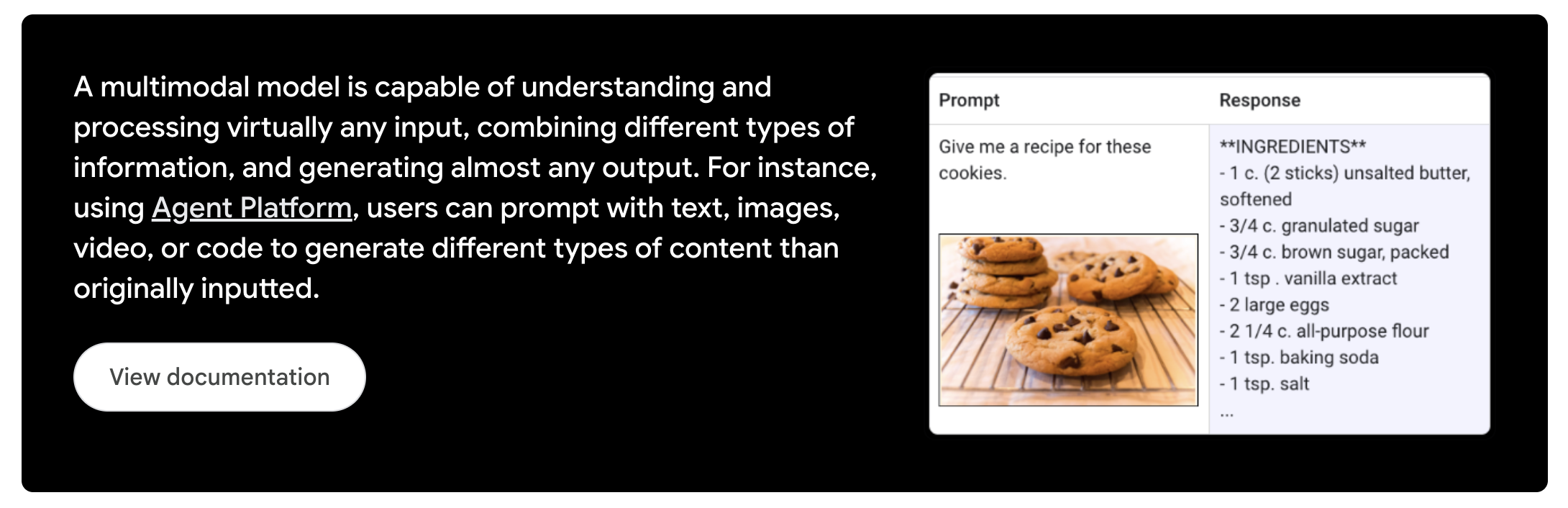
Useful information is not always stored as clean digital text. It may sit in photographed documents, voice recordings, and community video. Multimodal models can analyse images, speech, and video, alongside written text. Because the same model or service can work across several formats, developers may need less integration work to build applications around the information people already use.
Shared protocols are making it easier to connect AI to other systems
The emergence of shared protocols reduces the technical barrier to integrating AI with data, software, and other AI systems. Model Context Protocol (MCP) provides a common way for organisations to make data and software tools available to compatible AI applications. The World Bank, for example, is building an MCP server intended to allow AI systems to identify and interpret its development data. Agent2Agent Protocol provides a common way for independently built AI agents to communicate and coordinate. Over time, protocols like these could make it easier to assemble connected AI systems.
Together, these shifts are making “AI + X” easier to add to existing tools, services, and workflows. They are also creating some of the building blocks for what might come next.
Beyond ‘AI + X’
Our early research points towards something more transformative. AI could become part of systems that help people rehearse possible futures, organise humans and machines around a goal, and discover better ways to achieve it. Here are three signals we’re spotting.
From predicting events to testing possible futures
AI is already helping improve forecasts of what may happen. Some AI weather models outperform conventional systems. AI has also improved flood forecasting in data-scarce regions: Google reports that its models brought forecast reliability in Africa closer to that available in Europe. WFP’s HungerMap Live now uses AI-based forecasting to project food needs across 16 Hunger Hotspots.
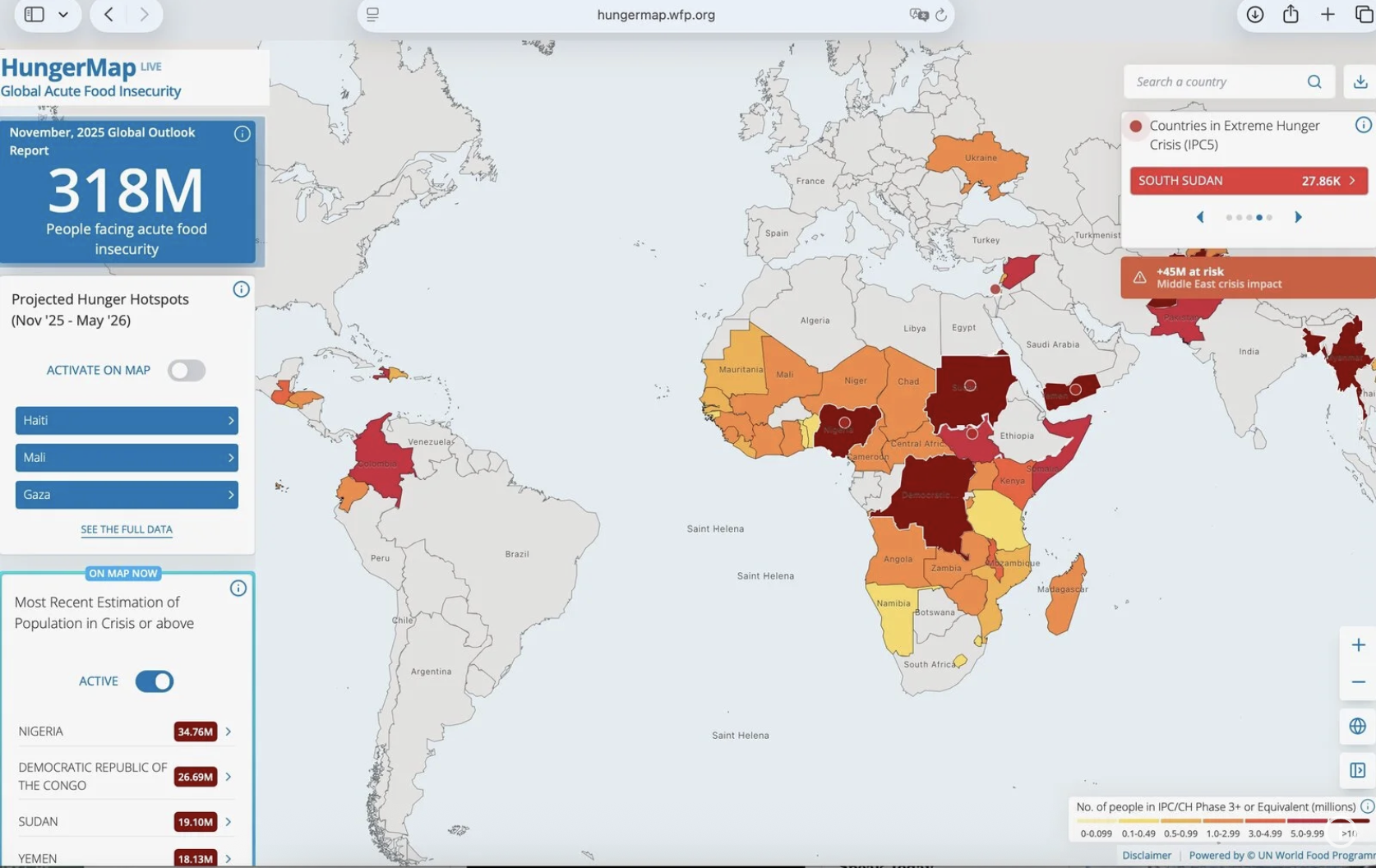
These systems usually forecast a particular event or outcome. The next frontier may be models that simulate how a shock could unfold across a connected system, and how different responses might change what happens.
Researchers are exploring the “transformative potential” of integrated early-warning systems that connect forecasts with geospatial and socioeconomic data. A weather model could forecast a cyclone’s path. Other models could show what lies in its way: a hospital likely to lose power or a community with no safe route out. Causal AI might then support what-if analysis by estimating how the outcome changes if people leave earlier or another shelter opens. Those researchers also point to agent-based models as a possible way to represent societal behaviour. Early social simulations such as AgentSociety signal that possible human responses could eventually be included in wider simulations.
AI cannot yet simulate a real community, economy, or ecosystem reliably. But these signals point towards systems that could explore how events might unfold and which actions could improve the outcome. Today, around 35% of crises are considered modellable, yet less than 1% of total international humanitarian assistance is made available to anticipatory action.
Could these advances make acting before a crisis the default, rather than the exception?
From automating tasks to organising collective action around a goal
When ChatGPT launched it could do coding tasks that took a person around 30 seconds. Today, frontier AI systems can complete some coding tasks that take skilled humans over fourteen hours. METR discovered this trend: the length of coding tasks frontier systems can complete is growing exponentially, doubling every 7 months.
AI systems are starting to divide work among several specialised agents. Oxford’s TrustedMDT is a multi-agent assistant being piloted for cancer treatment planning. One agent summarises clinical records, another determines the stage of a cancer, and another drafts treatment recommendations. An orchestrator brings their work together inside Microsoft Teams, where the system is designed to let clinicians question its reasoning and make the final decision.
Researchers are starting to test similar ideas in disaster management. Disaster Copilot proposes a central orchestrator that coordinates specialised agents to predict risks, assess impacts, and build a shared picture of what’s happening. A systematic review of 51 peer-reviewed studies found similar patterns across the field, including human–AI decision support, and the coordination of tasks, resources, and multiple agents.
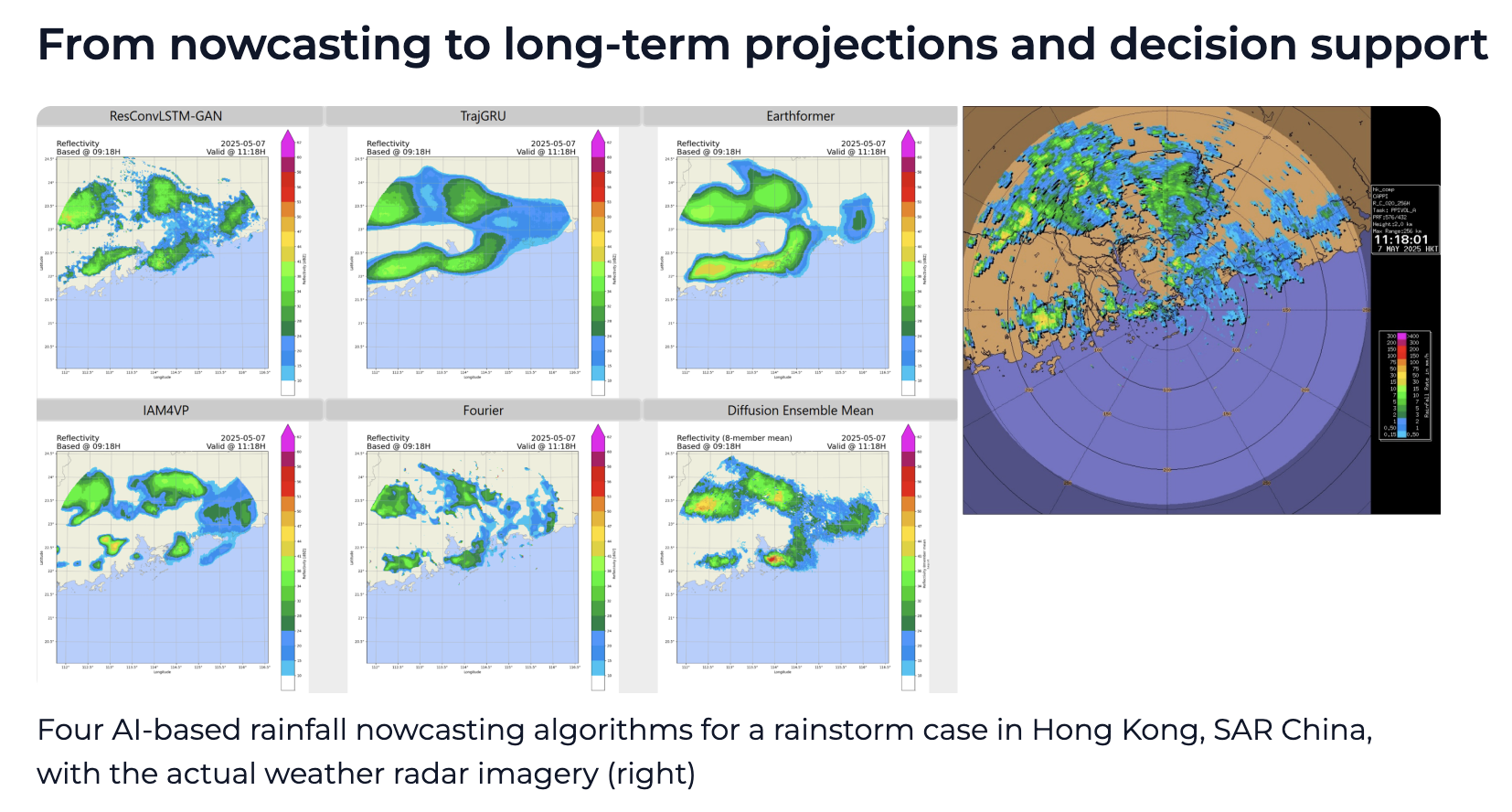
The World Meteorological Organization calls decision-support systems that combine several agents a “fast-evolving frontier” in AI-driven meteorology. It describes how “intelligent advisers” would combine several agents to orchestrate a workflow from data analysis to actionable guidance.
Today’s systems still operate inside workflows that people have designed for them. Researchers are testing whether the way agents are organised matters as much as the agents themselves. They argue that future systems may need to change how their agents are organised as conditions change: a possible shift from “self-evolving agents” to the “self-evolving multi-agent system”. Other research suggests that a mixed human-AI team behaves like a new organisation, not an upgraded one.
The next step might be an AI agent that orchestrates work across humans and machines. Researchers propose a “manager agent” that starts with a goal, maps the tasks required, assigns them to human and AI workers, monitors progress, and changes the plan when conditions shift. Could AI help groups reorganise how people and machines work together as conditions change?
From testing known ideas to finding unexpected solutions
AI can already automate parts of research. The AI Scientist is an early example of a system that can automate AI research from beginning to end.
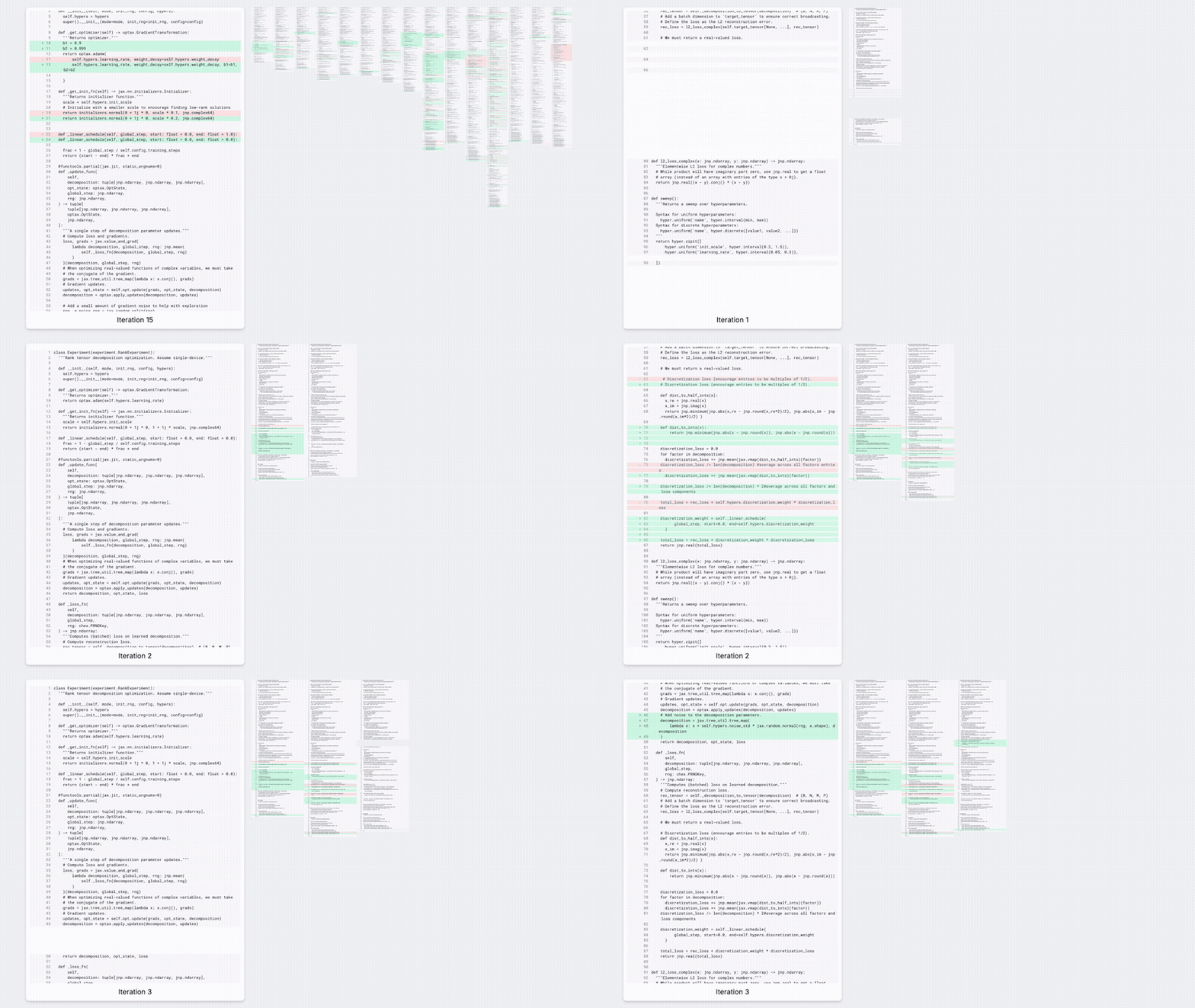
Some systems go further by repeatedly generating ideas, testing them, evaluating the results, and deciding what to try next.
AlphaEvolve does this with algorithms: it generates possible solutions, evaluates them automatically, and builds on the strongest. Applied to more than 50 open mathematical problems, it improved the best-known solutions in 20% of cases. This works because an algorithm can be run and scored, allowing the system to explore thousands of possibilities without waiting for a person to judge each one.
Scientific discovery is harder. An idea may require a physical experiment. Results may be noisy or ambiguous. Even deciding what would count as evidence can require human judgement.
Researchers are beginning to connect AI-generated ideas to real experiments. Co-Scientist generates, critiques and refines scientific hypotheses. Scientists tested its proposals in three areas of biomedical research, including drug repurposing and new treatment targets. People still set the research goal and conduct the laboratory work.
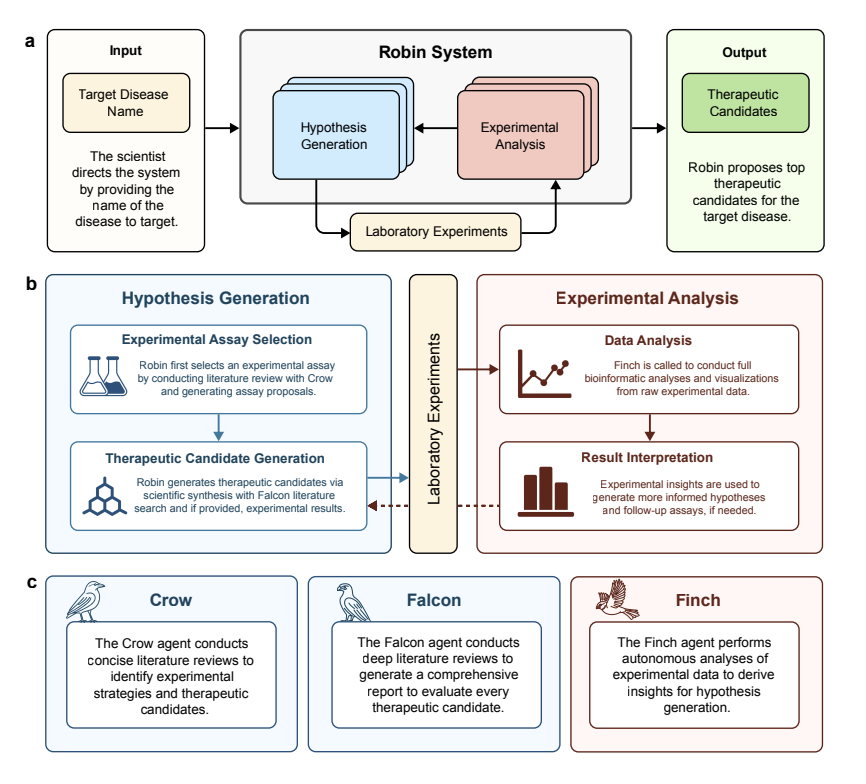
Robin closes more of the loop. It searches scientific literature, develops hypotheses, proposes experiments, and analyses the resulting data. It then uses those results to decide what to investigate next. Working with human researchers, Robin identified ripasudil as a possible treatment for dry age-related macular degeneration. The researchers found no previous proposal to use the drug for that disease.
The next frontier may be a move from closed-loop discovery in bounded environments to open-ended discovery in the real world. For international development, the opportunity may be to discover solutions built around local constraints, rather than adapt those designed elsewhere.
The most transformative capabilities may emerge when these come together. Combined, they point towards systems that could help institutions rehearse possible futures, organise people and machines around a chosen goal, then discover better ways to achieve it through action and feedback.
In part two, we’ll explore more about what this means for the sector (and what's worth testing).
If you’d like to dig in further…
⏩ Read the second blog on this topic
✉️ Explore our AI newsletter mini-series
🔈 Join the FT Network to receive an invite to join a Field Trip to the Future in September 2026