A blog by Matt Weatherall, sharing signals from the future of international development in the age of AI.
This is the second part of two blogs. Read part one here.
In the first part of this blog series, we shared shifts in the tech ecosystem that are making it easier to pair AI with other technologies in the development sector, and signals of a more transformative next chapter in which AI becomes more central to systems and goals. Each of the shared signals are early enough to act on but late enough to be grounded in real evidence.
Imagine this: a community-owned AI data steward
AI is built from what has already been recorded. When whole groups are missing from that record, new systems can carry their exclusion forward. Early approaches such as Lelapa AI’s Esethu Framework point towards a different model, in which communities help decide how their data is created, governed, and licensed. Our underhyped research proposed locally managed data trusts, local data hubs and community-controlled platforms through which communities could decide how their data is accessed, stored and shared. However, today AI datasets are often shared and repackaged without clear records of where the data came from or what its licence allows.
A Frontier Tech pilot in 2036 might test whether a human–AI system could help communities control not only how their data is used, but how they are represented in the AI systems built from it. A community might appoint an AI steward to manage its data. The community would set the rules. The steward would negotiate access, track how the data is used, collect payments, and withdraw access when agreements are broken.
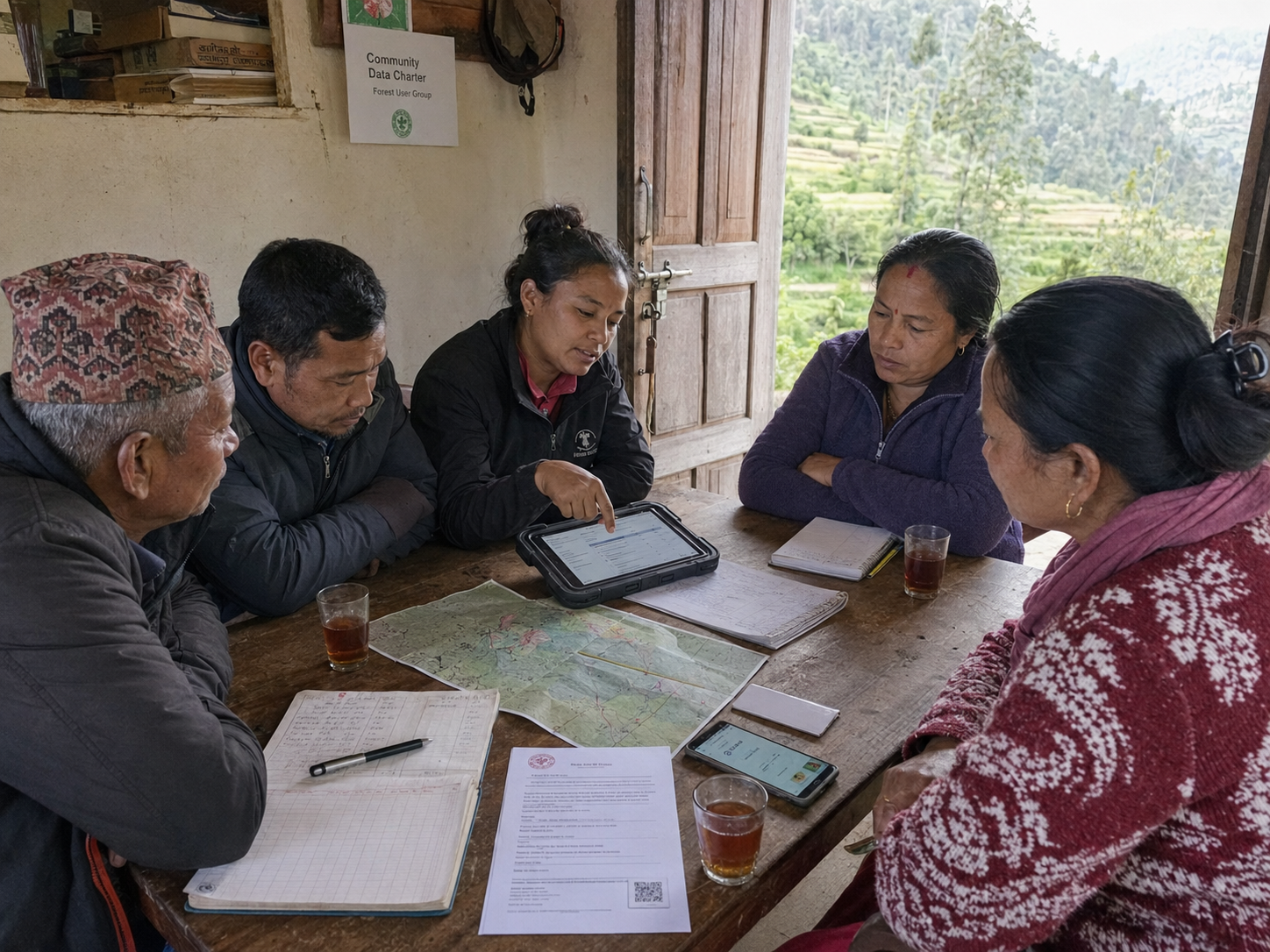
An AI interpretation of this future
In Nepal’s mid-hills, a community forest user group has managed its woodland for decades. By 2036, it also governs the data produced there: forest surveys, wildlife records, local plant knowledge and voice recordings from community monitors.
The community sets the rules. Sensitive knowledge cannot be used for model training. Commercial users must explain what they are building, pay for access and seek fresh approval if the purpose changes.
An elected data officer works with an AI steward to apply those rules. When an agricultural technology company requests data for a drought model, the steward traces each record to its source, checks the attached permissions and flags a clause allowing the company to reuse the data for other products.
The committee rejects the terms. It asks for a narrower licence, payment for local reviewers and changes to the way the model represents community land use.
The company never receives the raw dataset. Its model accesses approved records through the community’s data hub, where every use is logged. When a later version of the company’s model uses the data for an unapproved service, the steward freezes access and alerts the committee.
The AI does not govern the data. It helps the community enforce decisions that would otherwise be difficult to track once outside organisations begin using it.
So, what’s worth testing in this future?
For ten years, the Frontier Tech Hub has backed small experiments to find out whether emerging technologies can solve real development problems. One lesson has held throughout: technology is rarely the breakthrough on its own.
As AI becomes part of systems that shape decisions and actions, that surrounding system becomes part of the innovation challenge. That expands the frontier in three directions: fitting AI to real systems, building institutions that can work with it, and testing new arrangements that shift power over how it is developed and used.
Can AI work in the system?
We’re already seeing this shift in what FCDO staff want to test. In the Hub’s latest call, 62% of applications focused on system fit. One proposed integrating AI into public pharmacies. Others designed tools around existing forensic systems, or adapted services to work on basic phones without internet access.
The question is moving from "will the technology work?" to "can it work in the system?". The innovation may lie in adapting the technology to the system.
Can the system work with AI?
In healthcare, researchers argue that scaling AI is less about proving an algorithm works than building a health system that can work with it. The same applies across international development.
Falling aid budgets may push organisations to use AI to fill gaps, before they have the skills, safeguards, and institutional capacity to use it well. That creates a frontier for innovations around the technology: procurement methods that make risks visible, governance tools that support real decisions, workforce models that define where human judgement is still needed, and ways to monitor systems after deployment.
Some of this infrastructure is already taking shape. Fab AI, for example, has developed education-specific benchmarks that test whether models understand pedagogy, rather than relying on general measures of AI performance. In weather forecasting, the Weather Prediction Model Intercomparison Project is piloting shared methods for comparing AI-based, conventional, and hybrid models.
These types of innovations help shape how AI works in practice.
Who can decide what it’s used for?
As the sector renews its focus on locally led development, AI could strengthen local institutions’ ability to understand problems, make decisions, and act. AI is getting cheaper and easier to use. But access is not control.
Training the most advanced models requires growing amounts of compute and capital, putting their development beyond the reach of all but a small number of well-funded companies and countries. Local institutions may be able to use AI without being able to shape how it was built, what data it uses, or what it is allowed to do. External organisations may use AI to automate more of delivery while retaining control of the data, technology, and decisions.
Some groups are testing different arrangements: Lelapa AI’s Esethu Framework pairs African language datasets with a community-centred licence. It is designed to give communities a role in governing how their language data is reused and to ensure that some of the value created flows back to them.
The innovation may not be a new model. It may be a new arrangement that gives people greater power to decide what AI is built for and on whose terms.
The choices made now, and the experiments backed today, will help shape whether AI deepens divides or drives shared prosperity.
If you’d like to dig in further…
⏪ Read the first blog on this topic
✉️ Explore our AI newsletter mini-series
🔈 Join the FT Network to receive an invite to join a Field Trip to the Future in September 2026