An impact story from a Frontier Tech Hub alumni
Story captured by Ruth McPake, David Vigoureux and Amy Nye
Pilot: Drones for locusts
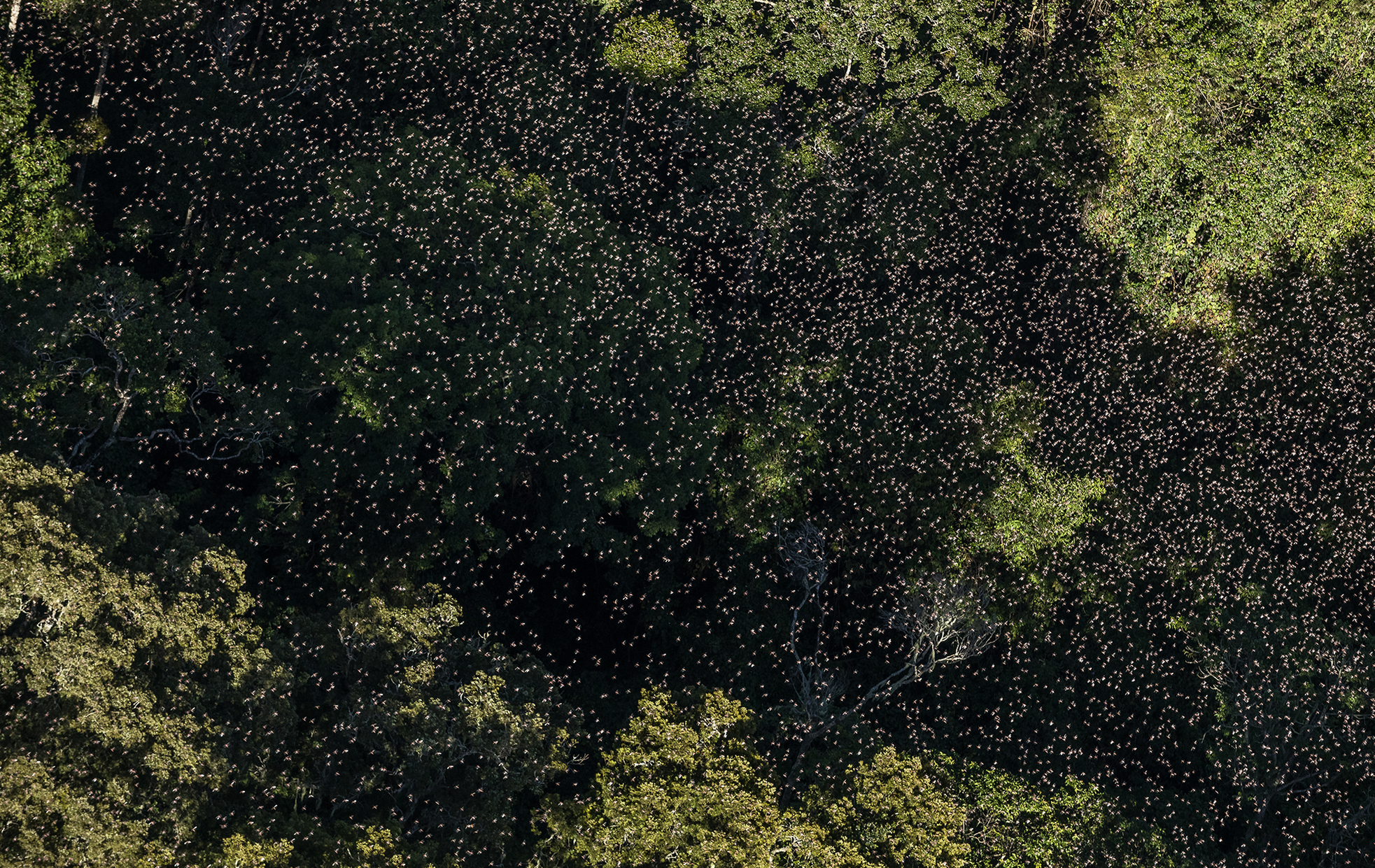
Locust swarms in Samburu County in February 2021 ©CABI & Astral Aerial
Violet Ochieng’ crouches beside a farm in Kenya, tablet in hand, reviewing multispectral imagery captured moments earlier by her drone. The false-colour maps reveal crop health patterns invisible to the naked eye. This data will guide the decisions made by local farmers about irrigation, fertilisation, and pest management over the coming weeks.
Today, this scene is routine for CAB International (CABI). Their drone work now spans five counties in Kenya, with individual mapping surveys covering up to 1,000 acres. Violet is now a licensed drone pilot, trained and certified to operate research flights across the country. The organization holds full authorization from Kenya's Civil Aviation Authority (KCAA) to conduct drone operations. Their Mavic 3 Multispectral drone has mapped invasive cactus infestations, assessed pawpaw orchards, and will soon help detect moths in local capsicum pepper crops using integrated sensors and smart traps.
But five years ago, none of this existed. CABI had no drones, no pilots, and no aviation authority clearance. Violet was an MSc researcher breeding locusts in a lab. The skills, equipment, partnerships, and confidence that define CABI's work today all trace back to a single, catalytic, exploratory pilot funded by the Frontier Tech Hub during East Africa's worst desert locust crisis in 70 years.
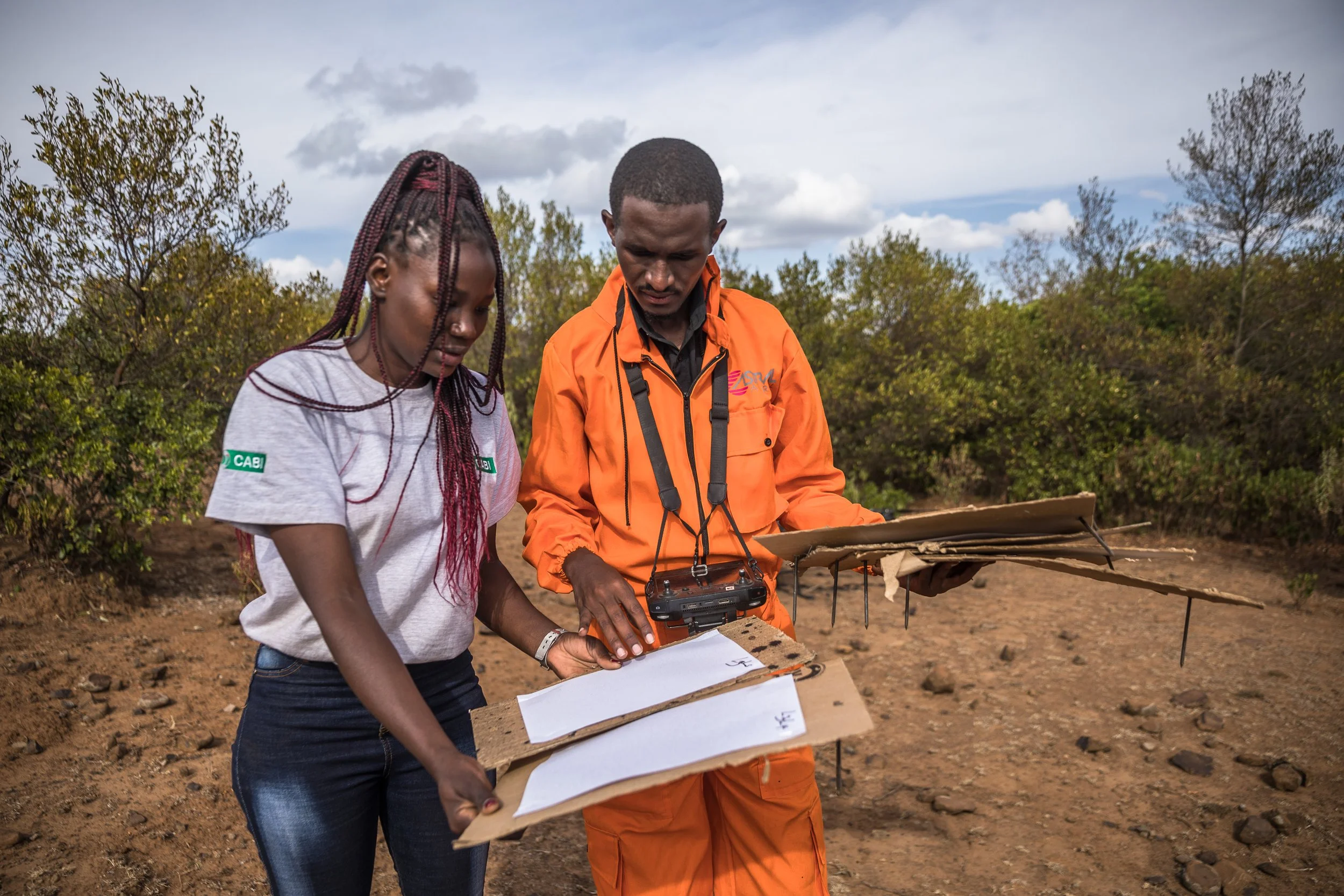
Violet Ochieng’ analyses ink spots that show the efficiency of drone nozzles.
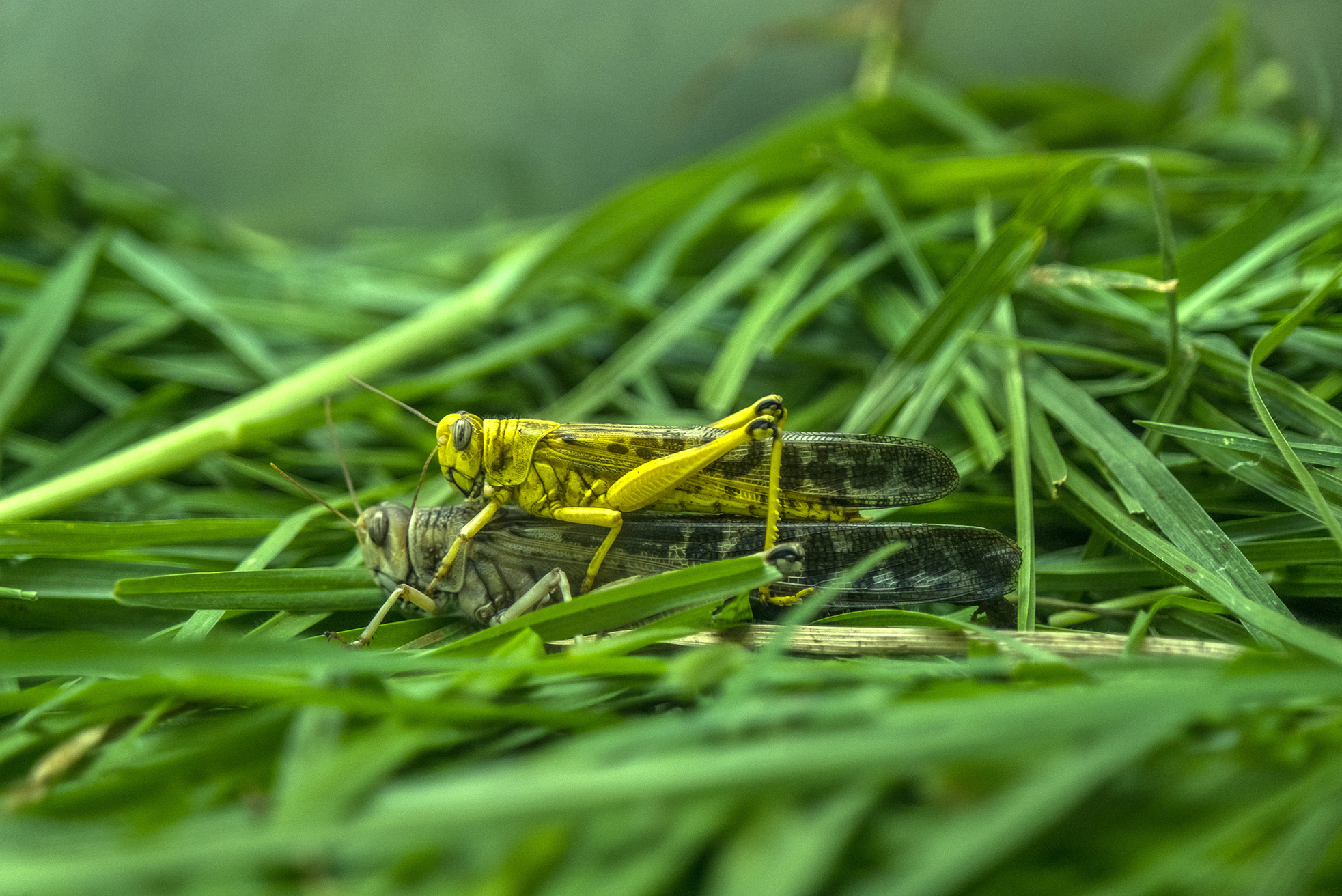
Two locusts in a cage at a CABI research facility in KALRO Muguga.
The journey from their pilot
2020-2022: Learning by doing, in the middle of a crisis
In 2020, desert locust swarms were decimating crops across Kenya, Ethiopia, and Somalia in what the UN Food and Agriculture Organization (FAO) called "an extremely alarming and unprecedented threat to food security." In response, the Frontier Tech Hub supported a pilot to explore an important learning question: “Could drones offer a complementary solution to traditional control methods?”
Nairobi-based drone company Astral Aerial and agricultural research organization CABI formed a team that combined Astral's technical operations expertise and CABI's scientific rigor. The team adopted a "learn by doing" approach, testing DJI Agras T16 crop-spraying drones and partnering with local scout teams in Samburu County, Kenya who knew where locusts roosted. They discovered that while locust locations were unpredictable and reaching sites physically challenging, early morning spraying before locusts flew away was feasible.
Then came critical feedback from FAO and national authorities: to integrate with existing control systems, the technology needed to use Ultra Low Volume (ULV) spraying. Although no one had retrofitted a DJI Agras drone with ULV technology before, Astral successfully built a custom system which improved battery performance, doubled coverage rate, and met FAO spray rates recommendations. The solution became comparable to existing methods, increasing credibility. Meanwhile, Violet led CABI’s research experiments, revealing how wind affected effectiveness, and informing pilot training on flight patterns.
By March 2022, the pilot had generated scientific evidence, trained local operators, and earned invitations to FAO's newly formed Locust Drone Technology Advisory Group.
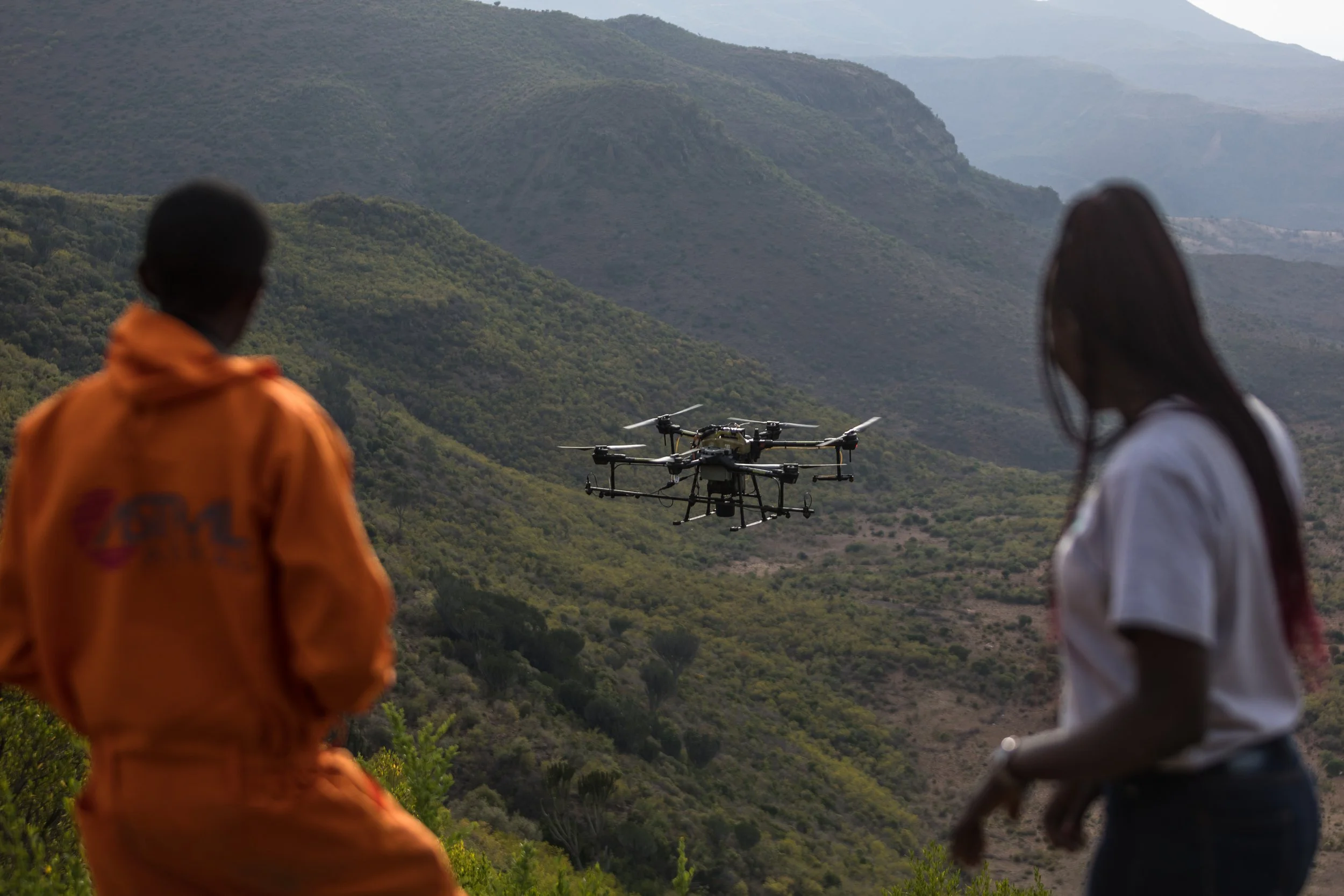
A drone test flight through hilly terrain in Samburu, watched by Violet Ochieng’.
2022-2025: CABI's independent flight path
With their sights on growth, CABI invested in building institutional capacity. In 2023, the organization supported Violet's training as a licensed drone pilot at Astral Aerial and obtained a mapping drone and received authorization from Kenya's Civil Aviation Authority to operate drones for research across Kenya.
With additional follow-on funding secured, CABI ran a 100-acre pilot to tackle Opuntia, an invasive cactus threatening arid communities. Drones identified infestation hotspots that would have taken weeks to survey on foot across vast, difficult terrain. More than 100 community members, deliberately selected to represent a variety of genders and ages, were trained in management practices and equipped to continue and scale up independently. By the time CABI returned to assess the impact, the community had expanded the treated area to 200 acres on their own initiative. CABI has also mapped pawpaw acreage and assessed crop health, testing whether drones could serve as early warning tools for farmers and are monitoring crops from planting through harvest.
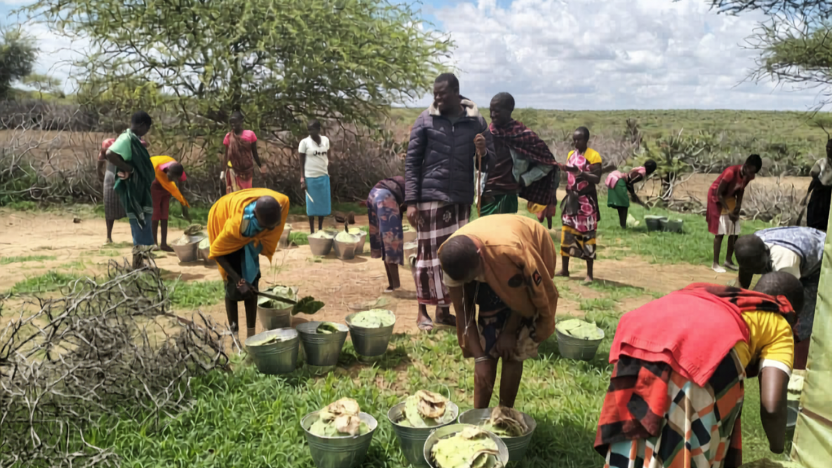
Community members in Koija preparing biological control agents.
©CABI
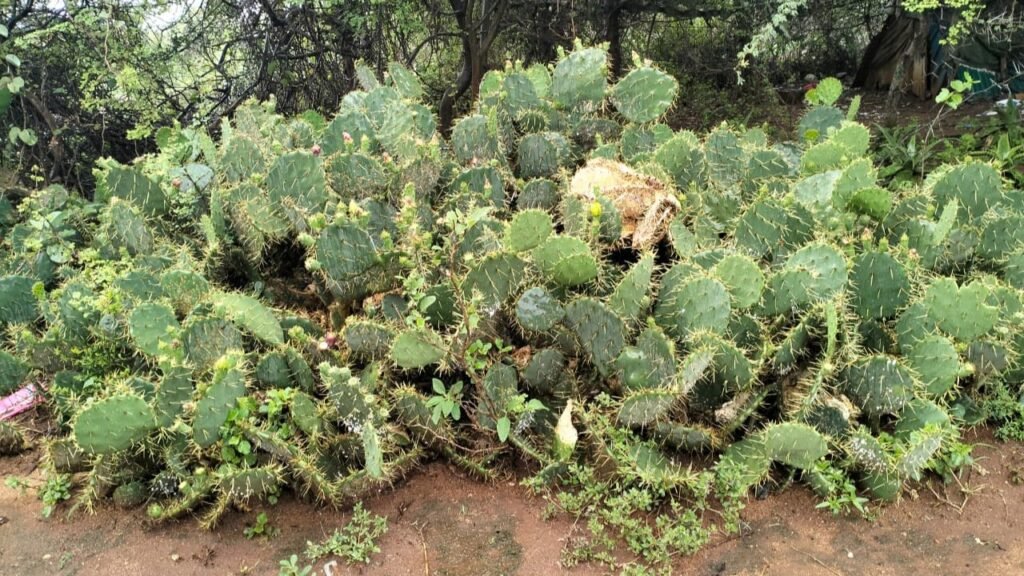
Opuntia engelmannii. ©CABI
CABI continues to prove themselves at the cutting edge of drone technology for agriculture by sharing drone data with academia partners, presenting on drone use cases at international platforms, and partnering with private and public sector organizations to explore drones for early detection of false codling moth, integrating drones with smart traps and weather sensors.
Throughout this expansion, the partnership with Astral Aerial endured. "The project built a relationship between CABI and Astral," Violet notes. "There's trust and friendship. Whenever we have a project and we don't have capacity, we will automatically partner with Astral because we've worked with them before."
What remains unseen
Permission to experiment
The Frontier Tech Hub's willingness to support risk-taking proved essential. Retrofitting the drone with ULV technology mid-pilot was expensive, unproven, and outside the original scope. Traditional research funding rarely accommodates such pivots.
"What I found most valuable was the exploratory approach," Violet reflects. "The coaching was very responsive. You'd come with what you had, and they'd say, 'Let's take a deeper look. How can we improve this to match industry requirements?' It opened our eyes."
The sprint-based methodology encouraged rapid iteration, with partners testing parameters, gathering feedback and adjusting, before testing again. This "learn by doing" ethos proved crucial when working with an unpredictable crisis where controlled conditions couldn't replicate real-world complexity.
The pilot also unfolded against a compounding backdrop of challenges. As government spray campaigns brought locust populations under control across Kenya, the team found themselves with drones and objectives, but no locusts in the field to work with. Their solution was to establish a laboratory colony, rearing their own locusts so that experiments could continue. Then, COVID-19 lockdowns made travel to the field sites near-impossible. Breeding locusts in Nairobi turned from a workaround into an advantage: the team could continue generating data without leaving the city.
Confidence, and the doors it opens
Completing a rigorously documented FT Hub pilot with international stakeholders gave both Violet and CABI something that no amount of desk research could provide: credibility with the people whose trust opens doors.
"The pilot study added trust," Violet explains. "I've submitted many proposals. The first question is always, 'How can we trust you?' When you mention this experience, you get a listening ear." That trust translated into concrete outcomes: follow-on funding, data-sharing partnerships with academics, and policy input to regional bodies. It also established Violet as Kenya's country representative for precision agriculture.
“The Desert Locust project was a game changer for CABI. Partners are coming to us, people believe in us, because of the work we did with Frontier Technologies. We are grateful, and we are looking forward to working on many more projects.”
The FT Hub spice
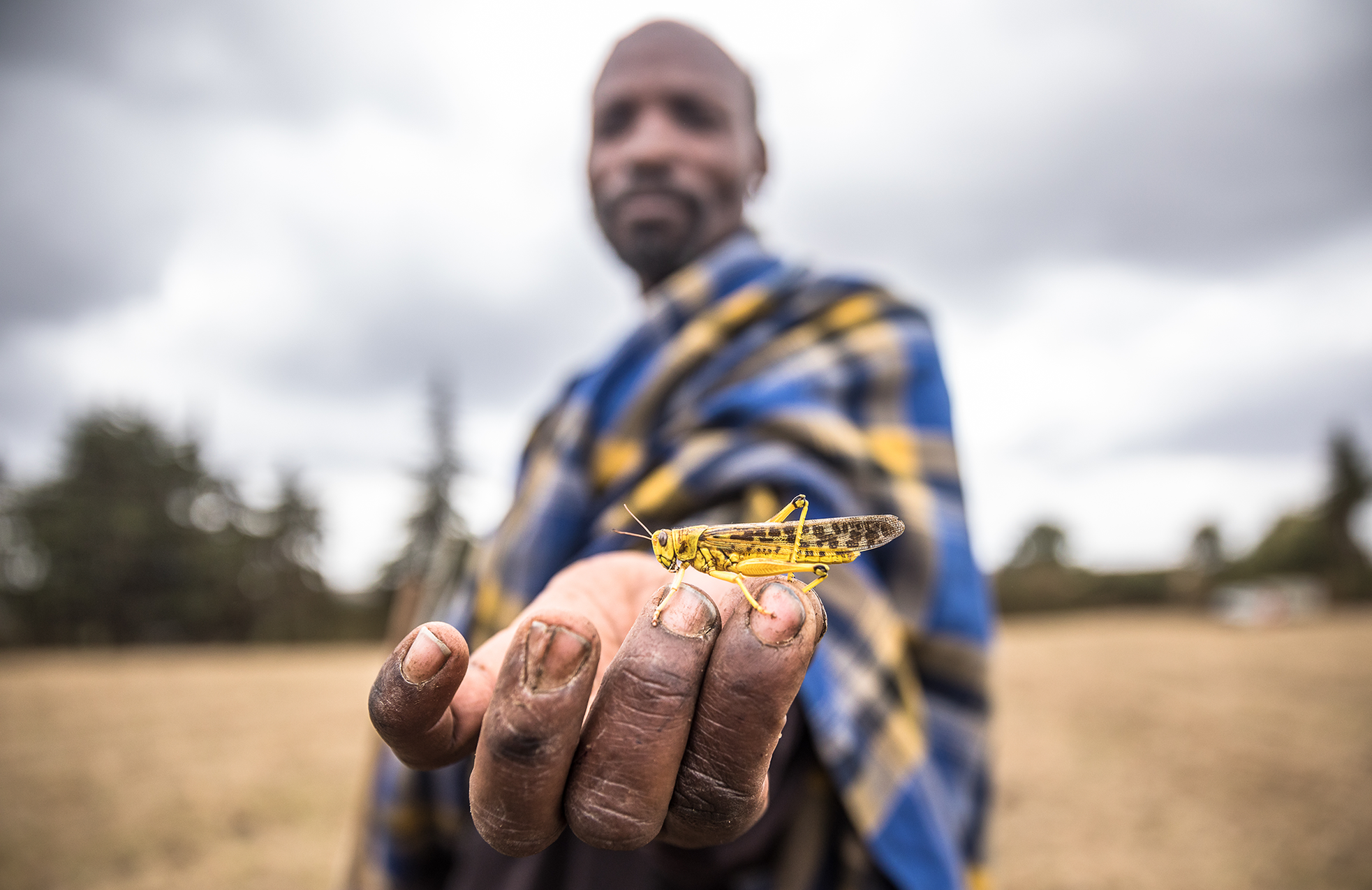
A villager holds a locust from CABI’s research samples.
What wouldn't have happened otherwise
Without FT Hub funding, CABI would not have developed drone capacity during the 2020 locust crisis because they lacked equipment, expertise, and connections. The window for learning under real conditions would have closed.
Without permission to pivot mid-pilot, the ULV retrofit would not have been possible. The solution would have remained incompatible with FAO systems, limiting credibility with stakeholders whose adoption matters most.
Without the "knowledge generation" framing, the focus would have been on immediate mortality counts rather than rigorous parameter testing and standard operating procedure development. The scientific evidence that now underpins CABI's proposals and partnerships wouldn't exist.
Perhaps most significantly, Violet would not be a licensed drone pilot, Kenya's country representative for precision agriculture, or positioned to lead CABI's expanding drone research portfolio. CABI Kenya would not hold KCAA authorization, own equipment, or have the track record that opens doors with partners across the region. They would not be part of FAO’s Advisory Group, which gives them a platform for influencing technology and policy alike.
“I can say clearly that I have reached here because of the support I received from the Frontier Tech Hub. I was given the opportunity to work on something unique that people will still reference 10 years from now. Getting that new skill and knowledge that you can share, a skill that will never expire, that is the most valuable thing.”
Where the flying goes next
This story proves that early-stage exploratory funding can catalyse impact that far exceeds the original scope, budget, and network. Crisis moments, like the locusts in 2020, offer unique learning opportunities if funders and implementers can move quickly enough to capitalize on them. CABI's evolution from rapid response to the immediate crisis that was then scaled up across the country with additional use cases demonstrates that well-designed exploratory funding, paired with the right team, creates foundations for growth that can compound over time. However, technical innovation alone is not enough. Violet’s training and CABI’s established partnerships allowed the small investment from the FT Hub to have a catalytic impact.
CABI’s ambitions for the next phase are concrete. Plans are under way to acquire additional spraying drones, customised drones for releasing biological control agents, and an upgraded mapping drone, expanding from a single-pilot operation to a multi-drone research centre capable of reaching farmers across Kenya’s 47 counties. At just 5% adoption, drone technology in Kenyan agriculture remains in its infancy. CABI’s goal is to change that through evidence-based research, capacity building, online training, and harmonised cross-border drone regulation developed through partnerships.
The journey from emergency response to capacity at scale continues, building on foundations laid when the FT Hub asked a simple question: could drones help control desert locusts? The answer turned out to be about far more than locusts. It was about what becomes possible when exploratory funding meets curious minds, enabling institutions, and the freedom to learn by doing.
If you’d like to dig in further…
🔘 Explore this pilot’s profile page
🔘 Navigating without a map, Violet’s story around IWD 2026
🔘 Explore the pilot’s Readymag story — “Drones Vs. Locust”