Finding and supporting those ‘left behind’ in urban public health systems
A blog by the Frontier Tech Hub
Pilot: eTriage for social inclusion: navigating out of vulnerability situations

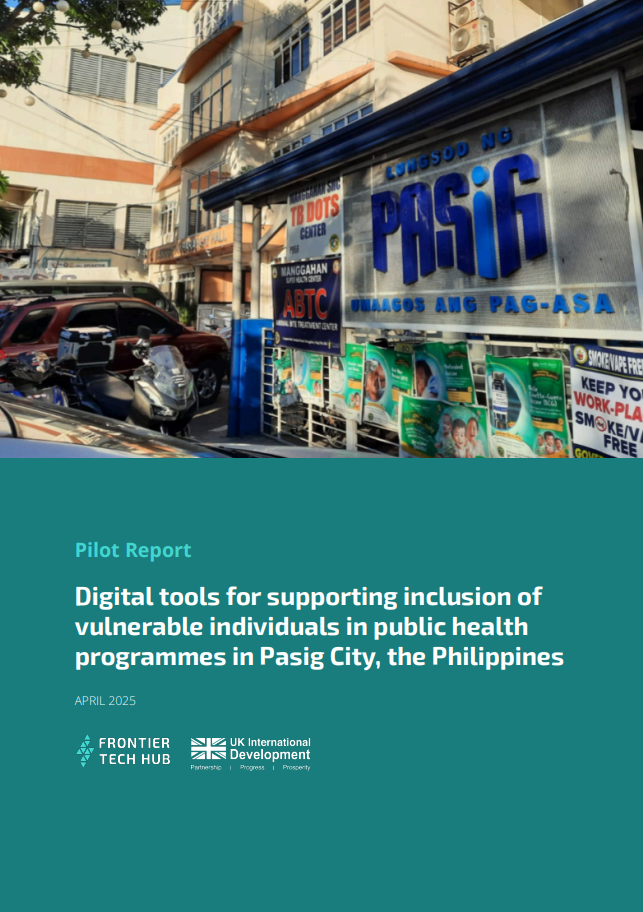
Manggahan Super Health Center, Pasig City, Philippines
Local governments across the Philippines are increasingly digitising health records to improve service delivery, yet many of the most vulnerable people still struggle to access care. In Pasig City, a dense urban area within Metro Manila, health workers delivering non-communicable disease (NCD) services face a persistent challenge: identifying individuals who are eligible for care but have stopped attending appointments altogether. These “lost to follow-up” patients are often those facing the greatest barriers, such as financial constraints, disabilities, insecure housing, or lack of information. Without timely outreach, they risk being further excluded from essential health services. This pilot, led by Ateneo de Manila University in partnership with Pasig City and the Frontier Tech Hub, explored how digital tools could better support inclusion in this context
The pilot built on an existing city health information system, the Multi-Programme Local Mapping Tool (MuPLoMT), which already supports over 50 health facilities in managing NCD care. The original ambition was to develop an AI-enabled vulnerability assessment tool that could automatically identify and prioritise the most at-risk individuals across health and social programmes. However, early user research with clinic staff, programme managers, and policymakers quickly reframed the problem. Health workers did not primarily need complex predictive models; they needed clearer, more actionable data on who had stopped accessing services, and practical tools to manage outreach in already overstretched systems.
Three core questions guided the pilot:
First, what information and features do frontline health workers actually need to identify and support vulnerable individuals?
Second, what technical and data foundations would be required before AI-driven vulnerability prediction is feasible or responsible?
Third, once new digital features are introduced, what does it take for them to be meaningfully adopted and used in day-to-day health service delivery?
The pilot addressed these questions through user research, iterative prototyping, system development, and a formative evaluation of uptake and early outcomes.
The first major finding was that improving basic visibility of “lost to follow-up” patients was far more urgent than building new AI tools. Much of the relevant information existed only in paper records, making it difficult for clinics or city-level managers to identify who had missed appointments or where outreach was most needed. In response, the pilot introduced new digital features within MuPLoMT to tag patients as lost to follow-up, record reasons for disengagement, generate outreach lists for barangay-level health aides, and provide dashboards showing trends across communities. Crucially, these technical changes were paired with new workflows, guidance, and a formal policy issuance to embed their use into routine practice.
The second finding was that while AI-driven vulnerability assessment remains a compelling long-term vision, it is not yet viable without significant data integration. The pilot team found that health and social services in Pasig City operate across fragmented systems, with different definitions of vulnerability and limited data sharing. They sometimes still relied on printed reports. Without joined-up datasets capturing social, economic, and health risks, predictive models cannot be responsibly trained or tested. However, the pilot identified practical intermediate steps, including integrating MuPLoMT with the National Household Targeting System, which identifies households classified as the poorest and most vulnerable, creating immediate value while laying groundwork for future analytics.
The third finding focused on adoption and impact. Early signals were promising: recorded re-engagement of lost-to-follow-up patients increased substantially after the new features were introduced. However, the evaluation could not conclusively link these changes to the digital tools alone. More importantly, it revealed that many health workers lacked awareness, confidence, or training to fully use the system. In some cases, digital insights were filtered through a small number of “encoders,” limiting broader ownership and sustainability. As a result, the pilot increasingly prioritised capacity building, hands-on training, and support for managers to use data for decision-making, not just reporting.
Overall, the report highlights a critical lesson for digital health and AI initiatives: inclusion is rarely unlocked by advanced technology alone. In Pasig City, meaningful progress came from strengthening foundational data, aligning tools with real workflows, and investing in people’s ability to use them. AI may yet play a role in identifying vulnerability at scale, but only once systems are interoperable, data is shared responsibly, and frontline staff are supported to act on insights. For cities seeking to ensure no one is left behind, this work underscores that digital transformation is as much about algorithms as it is ensuring the fundamentals: process, capacity, and trust.
To read the report in full, click below:
If you’d like to dig in further…
Date published: 12th December 2025