An impact story from a Frontier Tech Hub alumni
Story captured by Amy Nye, Ben Britton and Alex Bailey
Standing on a rooftop in downtown Kisumu, John Gershenson looks out over the street below and counts three people missing a limb. At the current market price, none of them can afford a prosthetic that would fundamentally change their daily lives and livelihoods. For now, there’s no simple answer to this problem. At high-end hospitals, companies might offer top of the line 3D printed prosthetics for $400 USD. But there is a company that has a vision to make these available for $20-30 USD, manufactured locally.
That company is Kijenzi, which translates to “little maker” in Kiswahili. Co-founded by John Gershenson and Ben Savonen, the team is made up of six engineers in Kisumu, Kenya who design moulds for injection moulding and do 3D printing for a wide range of products, from prosthetics and orthotics to parts for ventilators to fertiliser scoops for farmers. Although the team is small, they are plugged into a broad manufacturing network across five countries: Kenya, Rwanda, Burundi, Malawi, and Zambia.
Seven years in, Kijenzi is running in the black, providing the same product at the same price as overseas manufacturers, with turnaround times of weeks rather than months, and with more tailored packaging and delivery options than international suppliers can offer. Across East Africa, international NGOs procure millions of dollars of physical goods every year, most of it manufactured overseas. Every component that arrives by container from China is a contract that didn't go to a local manufacturer, a skill that wasn't built, a shilling that didn't circulate in the local economy. Kijenzi's bet is that this doesn't have to be the default, and a relationship with One Acre Fund is the first proof point.
The journey from their pilot
June 2020 - April 2022: proving the tech, but hitting a wall
When Kijenzi’s Frontier Tech Hub pilot began in October 2020, they set out to test whether they could build a replicable network of distributed manufacturing hubs across the region, focusing on prosthetics and orthotics. Kijenzi partnered with Nayla Prosthetics, a non-profit start-up in Sudan, successfully proving that they were able to 3D print prosthetic hands in two weeks, compared to the 3 months it would normally have taken Nayla. However, the business-to-consumer model underlying the plan proved too fragile, and the original vision was retired in favour of a business-to-business approach serving larger NGOs and Original Equipment Manufacturers who could handle their own distribution.
At the same time that Kijenzi was testing prosthetics and orthotics with the FT Hub pilot, they were also supplying the One Acre Fund with 3D-printed fertiliser scoops, filling gaps whenever One Acre Fund’s Chinese suppliers fell short, which was happening for roughly one third of the orders. Kijenzi proposed an injection-moulded equivalent, manufactured locally at scale, that would cost six to ten cents per scoop, compared to the one dollar they were currently paying. At the volumes involved, the difference ran to hundreds of thousands of dollars a year.
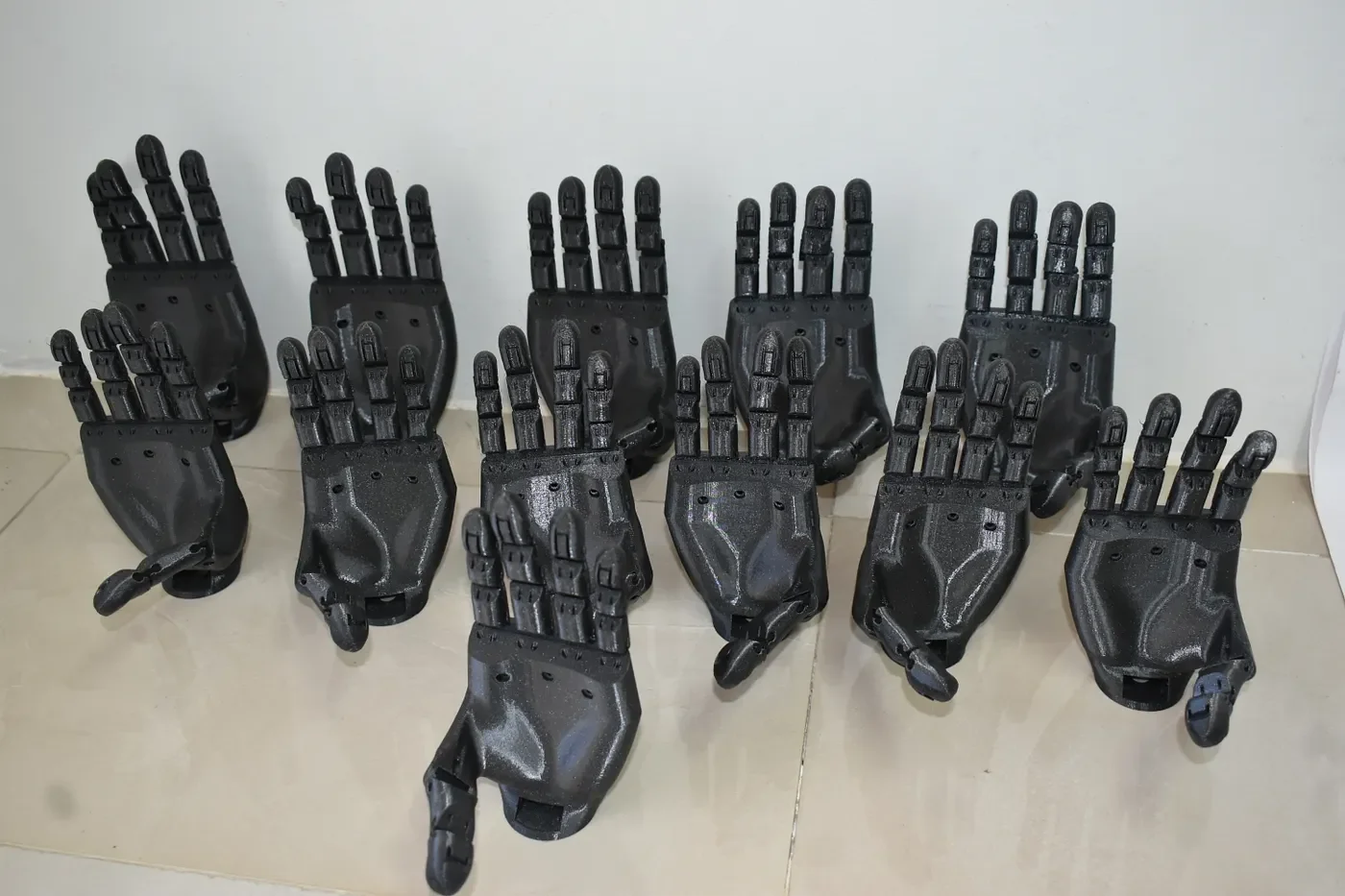
Freshly printed Nayla Prosthetics’ NUHA hands awaiting shipping to Sudan.

Kijenzi team member heading to see a customer for an emergency spare part.
However, One Acre Fund said no. They were keen on the idea, but they cited past disappointments with African manufacturers, their own short procurement horizons, not wanting to take the financial risk on moulds that would take multiple orders to pay off, or the risk on an unproven local manufacturer delivering at that scale.
January 2024 – March 2025: the mould that changed everything
As a consequence of One Acre Fund’s refusal, Kijenzi partnered again with the FT Hub in 2024, receiving approximately £30,000 to design and import moulds for the fertiliser scoops. With the moulds in hand, Kijenzi stepped in as One Acre Fund’s reshoring partner, absorbing the risk with the FT Hub's support, and proving their ability to deliver. More than a million fertiliser scoops have been produced since, at prices competitive with China, paid in Kenyan shillings. Lead times that once stretched to three and a half months now run to under 15 days. This quick turnaround time is critical for One Acre Fund because fertiliser application needs to be timed to the planting seasons, delays in international supply chains result in missed fertiliser, or the application of too much or too little fertiliser without an accurate scoop. This results in tangible consequences for soil health and crop yields, which in turn can have impact on income, local crop availability, and downstream nutrition impacts.
Since that first order, Kijenzi has become the first local hard goods manufacturer to be contracted with One Acre Fund, on an annual contract covering 5 countries.
What remains unseen
Permission to experiment
The focus of Kijenzi’s original pilot on prosthetics and orthotics didn’t succeed. In the FT Hub’s sprint model, each failure was designed to be run, assessed and either built on or discarded, and the process enabled just that. The challenge with 3D printing was finding sustainable revenue models to make it work in context. Kijenzi came out of the process knowing more about where to go next. When Kijenzi and the FT Hub re-engaged in 2024, Kijenzi had a clear vision of how they wanted to revolutionise local manufacturing, they just needed funding to take the next step.
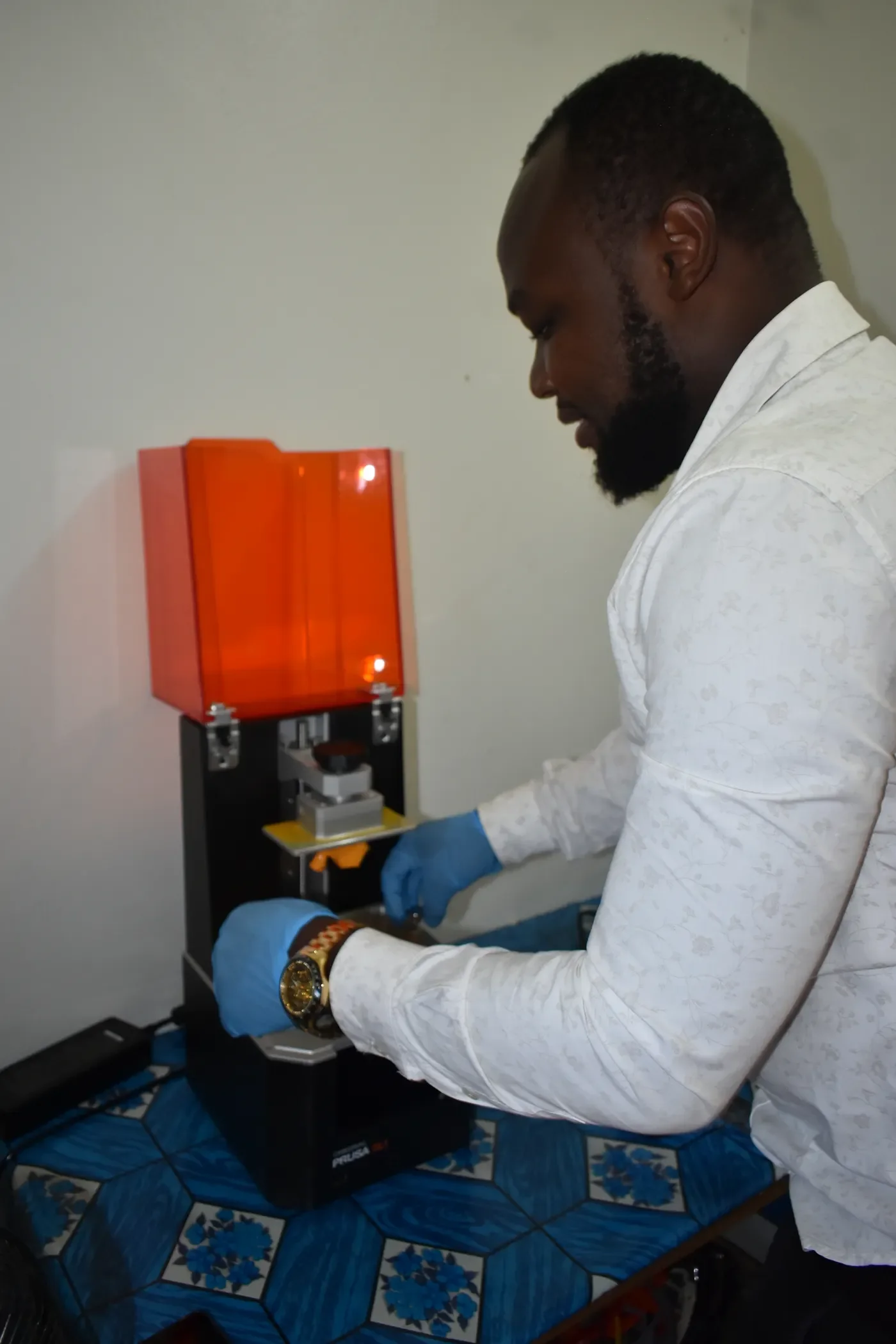
Kijenzi’s Hub Manager, David Okia, printing on a Prusa stereolithography (SLA) printer.
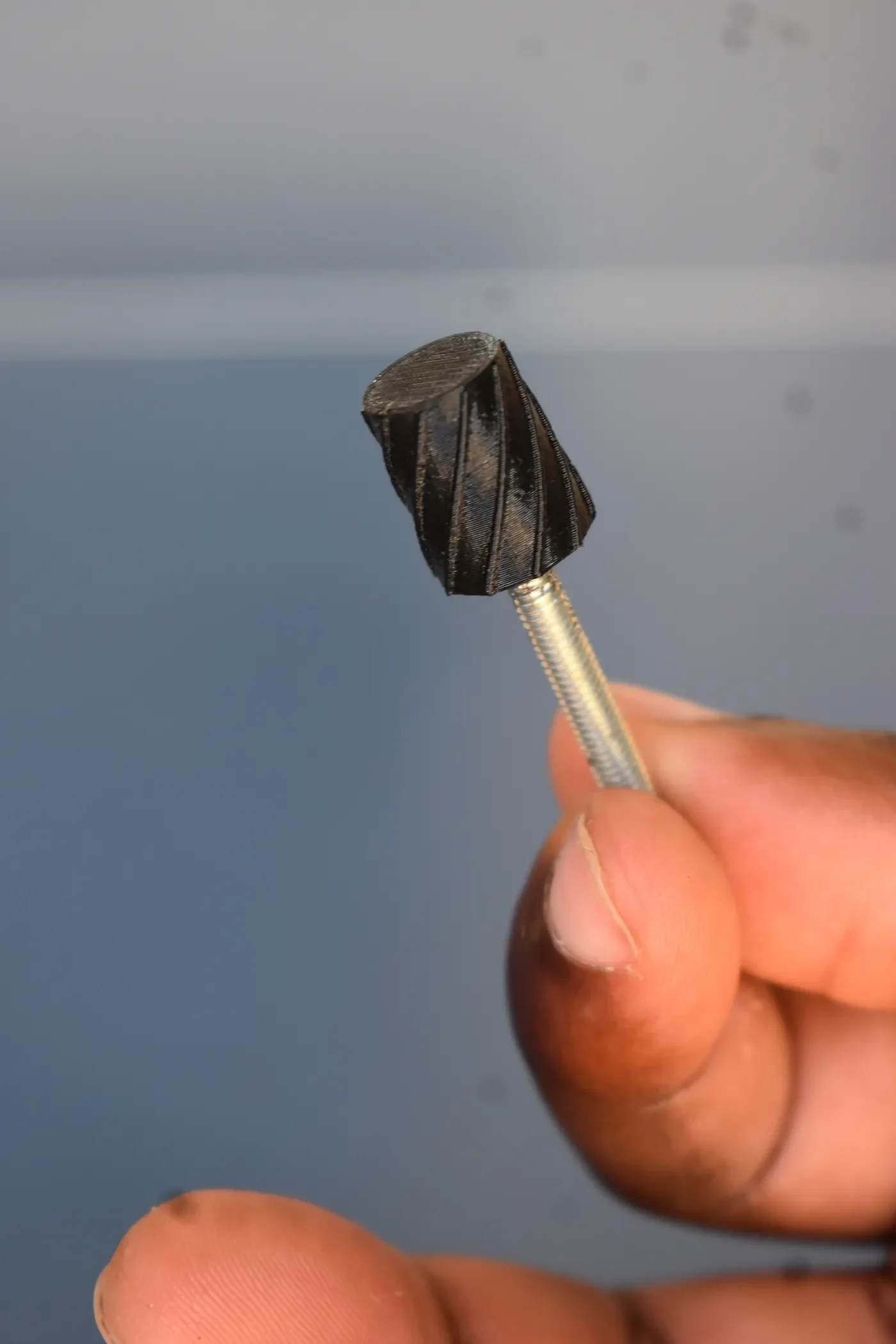
An assembled product for a Kijenzi customer.
Market Shaping
If a well-established NGO like One Acre Fund did not trust African manufacturers to deliver at quality and at scale, it is safe to assume most others do not either. What Kijenzi has demonstrated is a rebuttal: over a million units at China-competitive prices, delivered in under two weeks, with flexibility no overseas supplier can match.
The FT Hub spice
What wouldn't have happened otherwise
The turning point for Kijenzi really came from the second round of engagement with the FT Hub, starting in 2024, when the Hub invested in the moulds. One Acre Fund declined to take the risk, and without the FT Hub’s follow-on funding, Kijenzi had neither the capital nor the credibility to proceed.
“[The FT Hub] allowed us to buy the moulds and take this huge risk, because we didn’t know if they were going to have us make one thing and then never talk to us again. You all absorbed the risk for us.”
The entire reshoring business, now spanning five countries with over a million units produced and 3.7 million projected over the next three years, rests on a single investment of approximately £30,000. Before it, the company operated week to week. Now the reshoring revenue covers Kijenzi's full operating budget for 2026 with surplus available for research and development. “[The FT Hub] kick-started the programme. Now that programme can run in perpetuity.”
What else fits the mould?
Kijenzi's story demonstrates that local manufacturing in East Africa can be commercially viable and technically competitive over the long term as a self-sustaining business. That is a different kind of evidence to a successful trial, and John wants to use it. He says, “With 3D printing, Kijenzi was able to unlock localised manufacturing for innovators and small companies. This funding and proof of concept now allows us to unlock reshoring and localised manufacturing for organisations and companies of unlimited size.”
He identifies two groups he is actively trying to reach. The first is international NGOs with physical products they are currently procuring from China, particularly those who want to prioritise manufacturing where they work but haven’t yet seen a credible way to operationalise that. The second is impact enterprises, often non-African-owned, that have historically sourced wherever was cheapest and are now ready to take the next step on localisation. For both groups, the offer is the same: tell Kijenzi what you need to make, and they will find who in the region can produce it at the quality and cost required, whether that is Kijenzi itself or another local manufacturer they can connect you with.
So, what about the prosthetics? That ambition has not gone away. John still has eyes set on affordable and functional 3D-printed prosthetics, but he recognises that the healthcare system is not ready, and hospitals are too risk averse. But Kijenzi has proved that their model is sustainable, adaptable, and superior to the status quo. For now, they will continue the focus on reshoring and the work with the One Acre Fund, until the demand and trust is there to revisit their vision for prosthetics.
“I think we’re just a little bit ahead. The technology works. I think the healthcare system is just a little slow to evolve. And I think what’s really lucky for us right now is that we have this fantastic business model that keeps us running. We’re going to still be around so that when the healthcare system here evolves and is ready for us to get our 30 3D printers up and running and start producing more prosthetics and orthotics, we will be absolutely ready for it.”
If you’d like to dig in further…
🦽 An FCDO Pioneer's original story about how he set out to localise manufacturing in the Pacific.
📑 Read our evidence deep dive: Scaling Distributed Manufacturing in the Global South
⛴️ Journey with us as we explore the cutting edge of localised manufacturing across our portfolio