If you're not online, are you in the future?
This is a published version of our newsletter series. Click here to join the FT Network and receive our newsletter directly (alongside an audio version).
AI is a snapshot of the past. Ten years of AI pilots taught us that the constraint is rarely the algorithm.
Welcome to our AI mini-series. In this first of four issues, we’re sharing five buckets of AI, the perspective of a film composer and a future LLM powered by a spin class in the room next door to the office.
Most AI commentary is written by people who build it, fund it, or fear it. But since 2017, we’ve been testing it in the low-resource settings that Silicon Valley only thinks of when the nominations for peace prizes roll around.
That ‘we’ includes countless experts, practitioners and champions from the public and private sectors across 24 countries, from Ukraine to South Africa and Colombia to Nepal. Some of our ideas worked, and others didn’t. But every single risk and learning has contributed to the evidence base we’re drawing on here.
So welcome to our virtual makerspace (yep, also very 2017). Over the course of this mini-series, we’re asking questions like: What has AI actually done for the people who need it most, and what has it missed? Who decides what responsible AI looks like when the builders aren't the ones affected? Which tools are genuinely useful for development practitioners? And if AI reshapes everything, what does international development look like in ten years?
In the words of Louis Theroux, “Shall we get started?”
AI on a dusty road, nearly a decade ago
In 2017 (five years before the AI boom), the Zanzibar Department of Roads had a problem. Tanzania had an estimated 100,000km of rural roads in need of surveying, but manual methods could cover only 50km per day. A full survey would take 10 years.
A bold idea came forward: collect 1,200km of data via bump sensors, smartphones, GoPro cameras, and human observation, and use it to train a machine-learning model to interpret existing drone imagery. It achieved 73% accuracy in distinguishing good roads from bad. There were some errors, of course, but they were all due to poor image quality. The machine learning worked absolutely fine.
Another bold idea used AI to diagnose tuberculosis in the chests of South African miners. These workers had higher TB rates than almost any other community in the world, driven by silica dust and silicosis that reached an average of 25% among long-service workers.
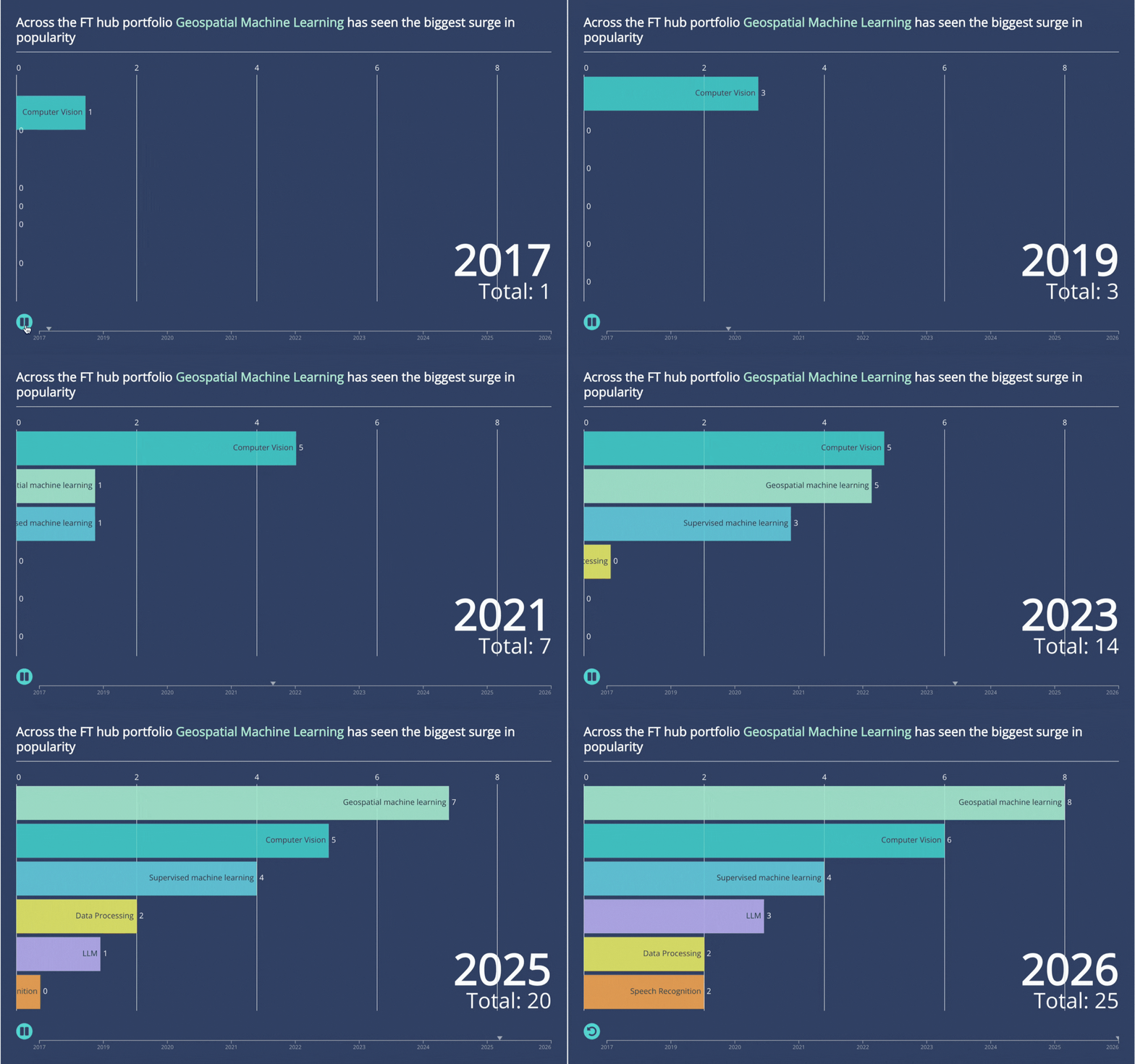
These were our first AI pilots. They both used Computer Vision, the first of five AI buckets we’ve identified across our portfolio, most of which existed long before ChatGPT made AI a dinner table conversation. Explore the other four buckets here.
"AI is a snapshot of the past being sold as the future."

Back in 2026, these words were quoted at a Responsible AI roundtable convened by FCDO recently. You might think they came from the lips of a tech ethicist or AI researcher, but they actually came from Hans Zimmer, the composer behind Interstellar and The Lion King. Someone whose livelihood depends on imagination outrunning what already exists.
Our Director was in the room with ethicists, academics, policymakers, and philanthropists. Her biggest takeaway was about what didn't get enough airtime: data colonialism, ethical licensing, and who actually shares in the value generated by our collective data (the data that then trains commercial AI products). One key design question sits underneath it all: who owns the data, and who does it serve?
“We talk about AI as if it’s here, for everyone. And yet 3.4 billion people are still offline. Most of them are in Africa and South Asia, and most of them are women. Women who aren’t online aren’t in the data.”
AI built on that absence overlooks and cements the exclusion of those people from every system that comes next. But Ravi Venkatesan argues in The Real Choice Confronting Developing Countries that exclusion isn't inevitable, it's a policy choice. With the right infrastructure, AI could lift productivity for the 1.5 billion informal workers that manufacturing-led growth never reached.

AI could never (work without the right infrastructure)
Let’s take that question about who is and isn't in the data and make it real. In Pasig City, Manila, it determined whether 24,000 people got their medication.
Nurse Betty works surrounded by years of paper folders stacked floor to ceiling. They are the physical record of every patient who, until recently, could disappear between the pages for years. Today, she has a screen instead. It shows her 250,000 registered patients and when they last came in.
24,358 patients haven’t been seen in a year across the city’s clinics. For most of these people, it’s not a problem, but 3,283 are vulnerable. They have non-communicable diseases like diabetes and hypertension, and need medication and monitoring every three months. Without it, their health will decline (and the inevitable cost to the national health system will grow).
When these vulnerable patients have been gone long enough, Nurse Betty can generate a list with their addresses and send a Public Health Aide to their door.
This pilot’s tool is game-changing, but it started out very differently. The team originally arrived with an AI pitch: something that could identify at-risk patients before they disappeared. The data to train it theoretically existed across Pasig City's health centres, but in practice, one clinic had a single encoder while everyone else wrote patient notes by hand. The Wi-Fi dropped so often that staff took laptops home at night to upload data when they had a connection.
As you might have guessed, you can't build a predictive model on paper folders. So the team built the foundation instead: a way to tag missed appointments, generate outreach lists, and record the reasons patients stopped coming. The AI pitch became the data infrastructure project that the health workers actually needed.
The team's original pitch was a utopian vision of AI, one of three types of AI hype in healthcare (utopian promise, dystopian crisis, and corporate takeover). This research argues that all three share the same underlying problem. They remove nuance and discourage curiosity about what is really needed.
“The danger of hype is that it closes the debate needed if AI really is to benefit healthcare.”
The team's original pitch was a utopian vision of AI, and the predictive AI element may well come in the future. The team has secured follow-on funding from the Philippine government and seeks to replicate the model across other cities.
For now at least, 3,283 data points humans are back in the picture.
Where this leaves us: the hard part was never the AI
AI is about more than LLMs, it's not new, and it’s not just for the Global North. The Hub has been testing it in low-resource settings for 10 years across five AI buckets (of which generative AI is only one).
And whichever AI type we were testing, the same pattern repeated across a decade and 24 countries: the breakthrough is rarely the algorithm. It's the quality (or availability) of the data, whether the infrastructure can carry it, and whether the people who need it most are in the picture at all. That's the lens we'll carry through the rest of this series.
In the next issue of this AI mini-series, we’ll be sharing insights on using AI to protect information integrity, combatting corruption in the Philippines and the practical questions innovators should be asking, even on early stage pilots. If you need a reminder why: we exist in a world where LLMs are shaping political discourse and Pokémon Go players unwittingly helped map the physical world for military drone navigation.
Until then, meet CrankGPT: a fully local, fully private, human-powered AI solution. Tier 1 runs on a hand crank. Tier 3 requires partnerships with gyms. No cloud required. No Claude required.
In other news
This is where we share recommendations from members. Our Network is all about collective insight, so if you’ve come across something worth sharing, get in touch!
Pope Leo XIV’s Magnifica Humanitas warns that AI power should not be concentrated in the hands of a few tech elites. Read the full encyclial letter or listen to a 7 minute podcast about it.
Kenya’s AI ecosystem is growing, but data remains fragmented. How can we bring it up to speed to unlock inclusive AI solutions? Read the new report from GSMA.
An absolutely beautiful AI-enabled data project visualising global migration flows over the past four decades.
Read the cross-sector analysis of the opportunities and barriers to scaling AI-enabled “big bets” in LMICs by the AI for Good Project.
When a robotics lab in Pakistan couldn’t find enough real footage of wildfires to train their AI model on, they used clips from video games like Red Dead Redemption instead - an example of ‘bricolage’.
If you’d like to dig in further…
✉️ Explore our other newsletter issues
⏩ Read the next issue in this series
🔈 Join the FT Network to receive the newsletter directly to your inbox (alongside an audio version)