Changing the user, not the technology
A pilot article by Beth Stephens from Smart Justice, a Frontier Tech implementing partner.
Pilot: Justice in Her Pocket: AI-assisted legal guidance for women in Tanzania
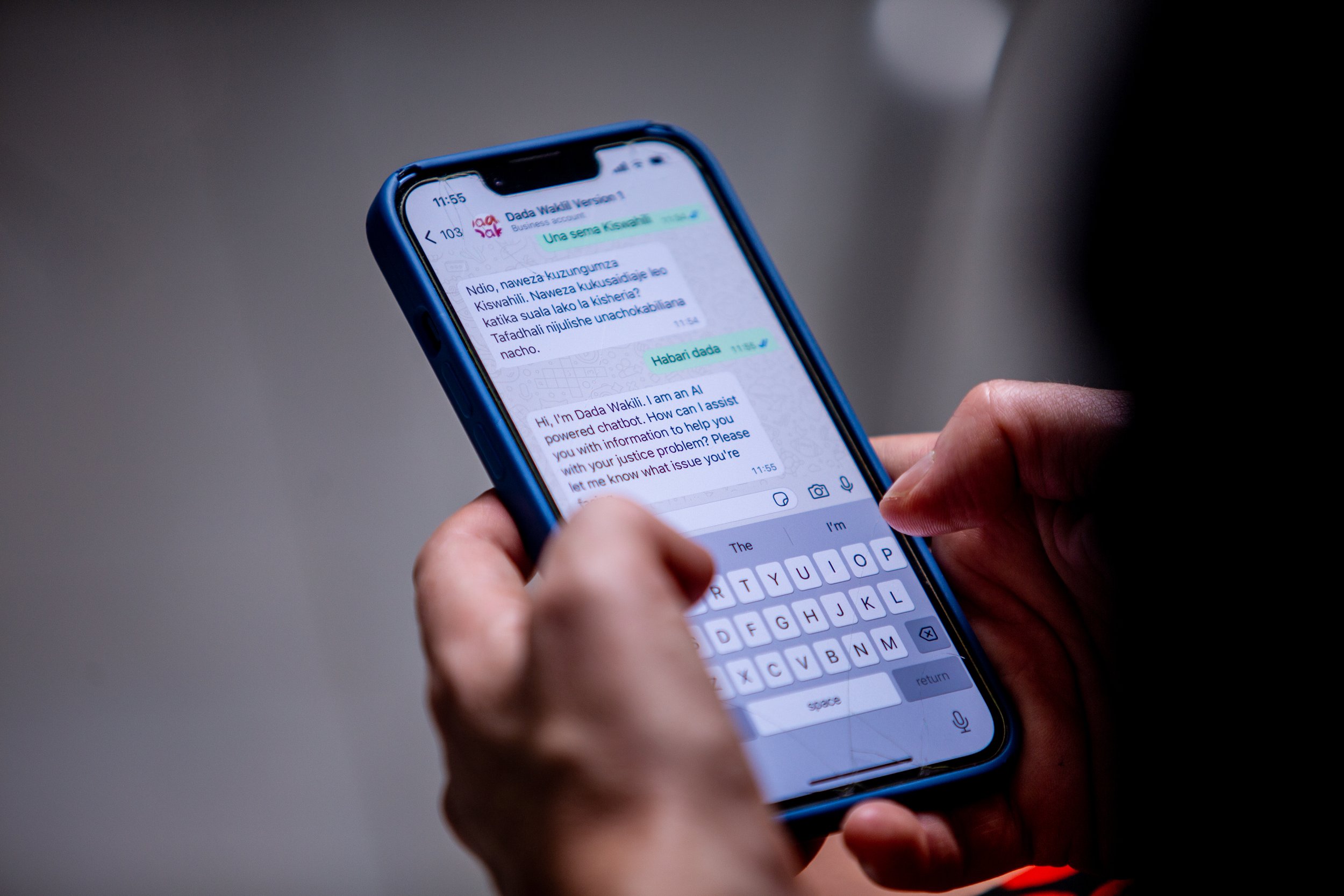
When building a tool to improve access to justice for women in Tanzania our biggest successes came from more than just improving the AI architecture, but from testing our ideas with the women and paralegals living these problems.
If a woman in Tanzania needs legal help, she rarely starts with the law. She turns to someone she trusts: a sister, a neighbour, or a community paralegal who has helped others facing similar situations.
She asks questions like:
"My husband has died. Can his family force me from our home?"
"My daughter's teacher beat her. What can I do?"
"My husband says he can take our children. Is that true?"
These everyday questions became the starting point for Dada Wakili ("Sister Lawyer"), an AI legal assistant available in both Kiswahili and English and trained on Tanzanian legal frameworks. It forms part of Justice in Her Pocket, a pilot supported by the Frontier Tech Hub, alongside FCDO Pioneer Felix Wood.
Over the past few months, the pilot has explored whether AI can make legal guidance easier to access by responding to the questions people naturally ask, rather than expecting them to navigate legal terminology or legislation.
The design of Dada Wakili is user-centred, relying on a series of experiments to test our ideas with women, work alongside existing institutions, and let the evidence reshape the pilot.
As the pilot progressed, those experiments challenged some of our most fundamental assumptions. One of the most valuable outcomes of experimentation, we discovered, is realising that the original question was only part of the answer.
The user we didn't expect
At the beginning of the project, we imagined women using Dada Wakili directly through WhatsApp on their own phones. Mobile phone ownership continues to grow across Tanzania, and AI offered an opportunity to put legal information directly into women's hands.
During our first sprint we tested this assumption, working with more than forty community paralegals through a series of workshops across the Kigoma region to understand how legal advice was already being delivered and where AI might be useful. However, many of the women we hoped to reach relied on basic feature phones, shared mobile devices or could not always afford mobile data. A chatbot designed solely for direct public use would never reach many of the people it was intended to support.
Instead, we found that across much of Tanzania, community paralegals are already the first point of contact for women seeking legal help. They know how to listen to a woman's story and are trusted within the communities they serve. Already using smartphones as part of their daily work gave us a practical, trusted way to bring Dada Wakili into communities. At the same time, Dada Wakili could strengthen their expertise by equipping paralegals with quicker and easier access to reliable legal information, practical checklists and clear next steps.
As Neema, one of the participating paralegals, explained:
"Dada Wakili will strengthen our services — it gives us prior information to share with clients about their cases."
This changed how we thought about the role of AI. Rather than focusing on providing legal guidance directly to women, the opportunity was to support the community paralegals who were already helping women every day.
Direct public access remains an important long-term ambition, but for now our priority is understanding where the technology can have the greatest impact.
When the law doesn't speak your language
At first, we assumed one of the biggest challenges would be translating legal information into Kiswahili. The deeper challenge was that legal knowledge is organised around legislation, not around how people describe their problems
As Rehema explained during one discussion:
"Mume wangu amefariki, ndugu zake wamechukua kila kitu. Niende wapi?"
("My husband has died and his relatives have taken everything. Where shall I go?")
Her question prompted us to rethink not just the language, but the structure of the legal knowledge behind Dada Wakili. Instead of organising information around statutes and legal concepts, we began organising it around the questions people actually ask.
This became one of the most significant lessons from the pilot. Improving access to justice is about making legal knowledge understandable, usable and relevant to people's everyday lives.
Looking ahead
The next phase of the pilot will move Dada Wakili from workshops into day-to-day legal practice. Community paralegals will begin using the platform during their casework while we gather structured feedback on how it fits into real advice sessions, where it saves time and where it still needs to improve.
Testing it alongside the paralegals who support women every day is how we'll learn where the technology earns its place, and where it doesn't.