What does AI mean for data analysts in government (and beyond)?
A blog by Amy Nye
The Frontier Tech Hub Helpdesk
A decade ago, “data analyst” usually meant wrangling messy datasets in spreadsheets to produce findings and recommendations for policymakers. In 2025, that’s no longer enough.
In 2018, the International Data Corporation predicted near-exponential growth for the global datasphere. More recently, Statista reported the global volume of data created, captured, copied, and consumed in 2024 as 149 zettabytes (ZB). This could raise the 2025 projection even higher than the 175 ZB originally anticipated below.
Figure 1. Annual Size of the Global Datasphere
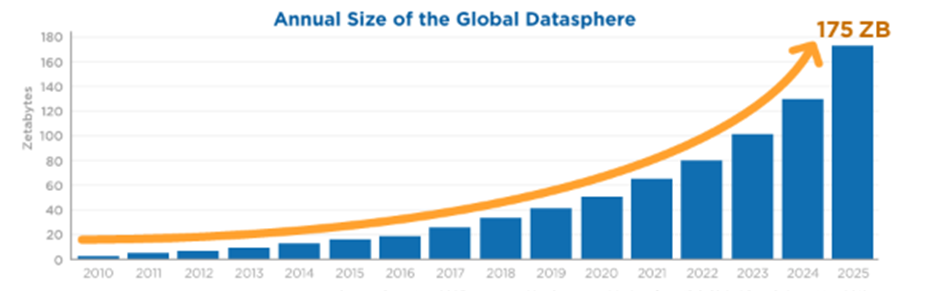
Source: Data Age 2025: The Evolution of Data to Life Critical
With this explosion of data comes valuable analytics and opportunities for governments, organizations and companies, and individuals to make evidence-based decisions.
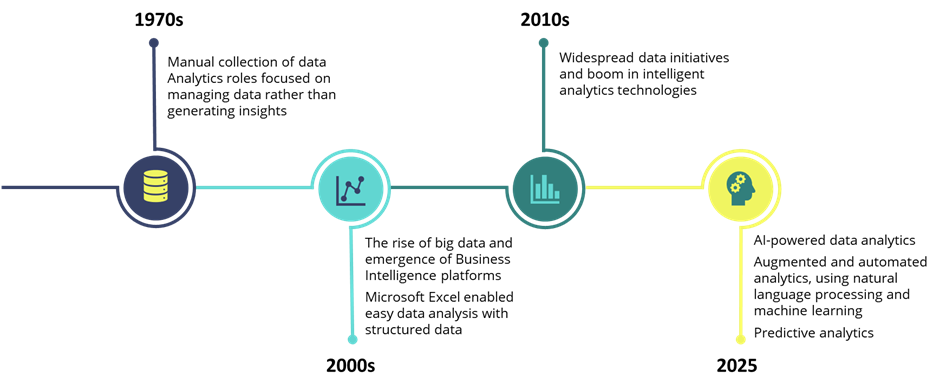
As the global quantity of data has increased, the ways of analysing it have also evolved. What started as a slow, manual process evolved in the early 2000s into the rise of big data driven by the emergence of Business Intelligence platforms, including Microsoft Excel, which made data analysis accessible to a broad audience. The 2010s saw a surge in intelligent analytics technologies like Tableau, SQL, and SAS.
Now, in 2025, artificial intelligence (AI) is transforming data science and analytics as the landscape quickly evolves to integrate AI-driven tools supporting everything from day-to-day operations to conducting policy analysis and simulating policy before it’s rolled out. Predictive analytics, which can not only summarize past findings but can harnesses data to predict what is likely to happen in the future. These types of cognitive analytics apply human-like intelligence and the use of data to enable real-time, informed decision making.
Figure 2. Evolution of data analysis capabilities
At the heart of this new way of working is the data professional, often called data analysts or data scientists. Once tasked with cleaning and analysing data and writing reports, today’s data roles are moving toward something much bigger: becoming strategic partners who help governments and organizations act faster, more fairly, and with better evidence.
From data analyst to data orchestrator
Where governments are concerned, there is a plethora of data—sensitive, internal reports accessible only to government staff, as well as external facing information from sources like news outlets—both of which have the potential to government agendas and decisions. While instant access to data sources provides opportunity to improve evidence-based decision making, it also brings about a new challenge: how to manage and maximize the large quantities of information.
Data professionals must navigate not just complex technology, but also complex organisations. They are becoming orchestrators of AI-powered systems that can customise models for specific needs and translate outputs into clear recommendations that non-technical colleagues can act on. These orchestrators need to have proficiency with the tech itself but also need to understand how their own organizational structure and department works and how to build trust in new tools so that they can make the connections required for governments to respond to challenges more effectively and efficiently.
Six new data orchestrator roles
This evolution is giving rise to entirely new roles inside government. Some of these tasks are familiar and are already carried out by existing government staff (although often manually, with less efficiency). Others are entirely new roles, meeting the needs presented by the integration of AI tools.
For those looking to integrate the use of AI tools into their teams, it is worth exploring how current organizational structures can be adjusted to accommodate the following roles:
· AI Coordinator: designs and implements AI governance frameworks, conducts algorithmic audits, and ensures responsible AI deployment across teams.
· Ethics and Bias Mitigation Specialist: builds bias detection systems, creates inclusive AI policies, and embeds ethics into analytical workflows and decision-making processes
· Modelling Expert: who fine-tunes language models for specific organisational needs, creates training datasets, and maintains model performance across different use cases and operational contexts.
· Policy Simulation Specialist: models policy scenarios, forecasts outcomes, and assess complex interdependencies across different program areas and geographic regions.
· Real-Time Intelligence Analyst: uses AI tools for continuous monitoring, early warning systems, and rapid response analytics for emerging situations.
· Knowledge Manager: manages AI-powered knowledge systems that capture, organise, and share institutional learning and decisions.
These roles are no longer “nice to have”, they’re becoming essential for governments that want to use AI responsibly and effectively.
The new technical toolkit
To effectively fill these roles, today’s professionals need a much broader toolkit than before. With the introduction of new AI-powered tools comes the need for a new set of skills with which to design, manage, and apply these tools and create effective analytical solutions.
Particularly relevant expertise includes:
· Natural Language Processing (NLP): Ability to build tools that understand and work with human language, including search systems, translations, and information retrieval, even in resource-limited settings.
· Large Language Models (LLMs): Experience working with leading AI models (like GPT, Claude, Gemini, Llama, Mistral), choosing the right one for the task, and designing prompts to get accurate, reliable results.
· AI Monitoring, Optimization, and Systems: Tracking how AI models perform, testing and improving prompts, and making sure systems stay consistent and reliable when models are updated or changed. Understanding how to set up AI systems on cloud platforms, organize information, and deliver real-time insights.
· Programming and Tools: Strong background in Python and modern AI libraries, plus experience building apps and prototypes with tools like Streamlit and managing AI projects with best practices in data engineering.
· AI-Assisted Coding: Comfortable working with AI coding tools (like Copilot, Cursor, Gemini CLI) to generate, debug, and refine code in ways that keep it secure, high-quality, and easy to maintain.
And because the field is rapidly evolving, continuous learning and adaptation isn’t optional. It’s part of the job description.
Governance and ethics matter more than ever
With AI comes risk. Governments handle sensitive data, from national security information to personal records. That makes questions of bias, fairness, and transparency unavoidable. When working with vulnerable or disadvantaged populations, this is doubly important.
Professionals in this space must develop new governance frameworks: running algorithm audits, designing privacy safeguards, and spotting vulnerabilities like prompt injection attacks. Done right, this ensures innovation doesn’t outpace safety.
Leading organizations are already developing guidelines on ethics and responsible tech integration, including UNESCO’s Recommendation on the Ethics of Artificial Intelligence, and OECD’s Advancing accountability in AI: governing and managing risks throughout the lifecycle for trustworthy AI, along with internal documents available for government staff. From the corporate world, companies like IBM and Microsoft are developing their own guidance on ethical considerations of foundational models and responsible AI principles and approaches. These materials provide critical guidance on how to appropriately make changes to organizational structure, upskilling, and programmatic ways of working to ensure safe, ethical, and responsible ways of working.
Building the new team structure
The rise of AI agents—semi-autonomous systems that can process data, draft outputs, and even hand off tasks to each other—allows for a delegation of routine workloads, freeing humans to focus on judgment calls, strategy, and ethical oversight. But it’s important to remember: AI cannot entirely replace humans, rather, it shifts the roles. Governments will still need people who can critically question results, adapt workflows, and make sure that AI-driven systems reflect democratic values.
The integration of AI will require an evaluation of how entire organisations adapt and upskill individual and institutional capacities. Legacy systems need to be set up to connect with modern AI tools. Teams need training and change management support, and teams need to ensure the data infrastructure is setup to accommodate AI-powered tools. In other words, governments can’t just hire a few data scientists and call it a day. They need whole teams that bridge policy goals with technical know-how, and leaders who understand both worlds.
Looking forward: The next 5 years
Data science is becoming a strategic driver of how governments design policies, respond to crises, and deliver services. Data roles are no longer back-office support functions. They’re becoming central to how organizations and governments work in an increasingly complex, data-driven world. This means that both governments and the individuals working for them will need to adapt their ways of thinking and working. For governments, it means structuring and upskilling their teams to build in these new roles and adapting their organizational structure to accommodate these changes.
For individuals to succeed, they must learn to become an orchestrator rather than simply an analyst. This means mastering not only new technical skills, but also the ability to navigate ethics, governance, and organisational change. Professional development in this area requires ongoing commitment to learning new technologies while maintaining established standards of analytical rigor and ethical practice. The integration of AI governance, multimodal analysis, and process automation creates opportunities for improved coordination across government units.
Governments that invest in this talent will be better equipped to handle the complex challenges of our AI era. Success depends on building teams that can bridge technical implementation with policy objectives. This requires both individual skill development and organisational change management to support new analytical workflows and decision-making processes.
If you’d like to dig in further…
🚀 Explore this pilot’s profile page: Using LLMs as a tool for International Development professionals
📚 Take a Fieldtrip to the Future: An exploration into how AI could change diplomacy in ten years’ time
📚 Explore the On the Frontier of Generative AI newsletter series
📚 Explore the AI Evaluation Playbook for the Social Sector: A comprehensive framework for evaluating AI systems in development contexts by The Agency Fund
📚 Read the Cross-Sector Analysis of the opportunities and barriers to scaling AI-enabled “big bets” in low- and middle-income countries by the AI for Good Project
Publish date: 05/12/2025