This is a published version of our newsletter series. Click here to join the FT Network and receive our newsletter directly (alongside an audio version).
As we end our AI mini-series, join us for a Field Trip to the Future (yes, really)
Welcome back to the Frontier Tech Hub's AI mini-series. This is our final chapter. If you missed the first three issues, catch up here:
After exploring AI in the past and the present, we promised to look into the future. We’re doing more than that, though. We want to take you there.
In this issue: an AI-controlled lab in DRC, five signals pointing to a possible future of international development in the year 2036 and an invitation to journey with us there on a Field Trip to the Future (September 2026).
The truly autonomous lab
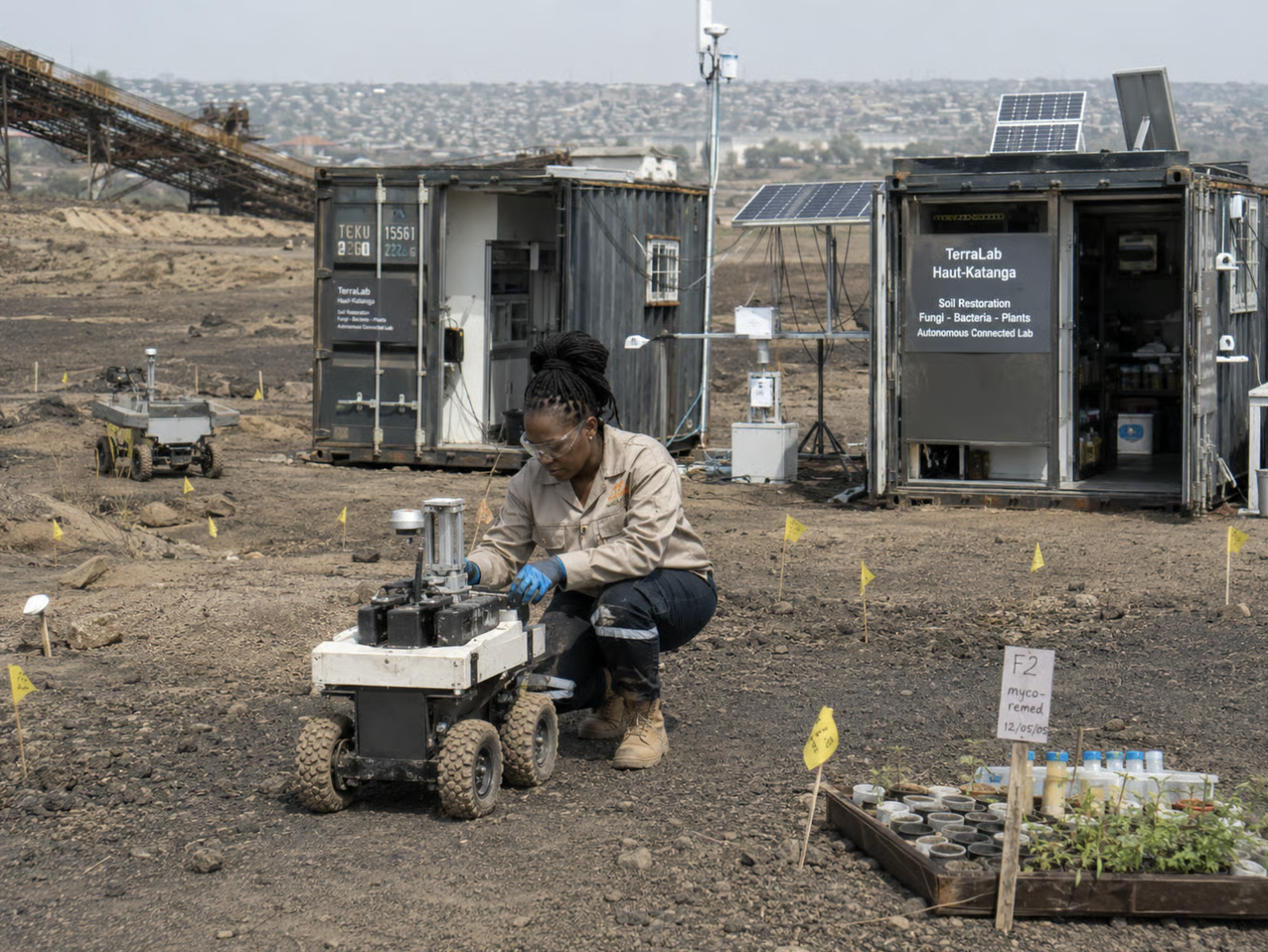
An AI interpretation of this future
The test plots are marked with yellow flags, each one a square metre of Haut-Katanga earth deemed “unrecoverable” by the mining company that departed in 2032. It’s only been six months since the autonomous lab arrived in two shipping containers at the vast brownfield, which for years had been empty but for the steadily thinning settlements on the horizon.
The lab runs continuously across the dusty, hot terrain. A system of sensors, incubation chambers and robotic samplers tests combinations of fungi, bacteria and plants against soil samples, observing which combinations reduce toxin levels fastest, iterating in 2-week cycles. It has run 2,300 experiments since February.
Adaeze and her team run scenario-based checks every week to stress-test the AI’s function in line with the UN’s 2030 regulations on autonomous decision-making. But so far, every experiment has been iterated autonomously. Three times a week, the robotic samplers rendezvous with Adaeze, one of the local technicians, for cleaning and maintenance. This is just about the only work the system can't do for itself.
The results of every experiment are uploaded to a shared dashboard in Lagos, where a central analyst examines experiments from three other labs across the continent. When the lab in Ghana finds a fungal combination that outperforms everything tried before, the system in Haut-Katanga runs it overnight.
Today, plot 6 is reading cleaner than anything so far.
The signals pointing to this possible future
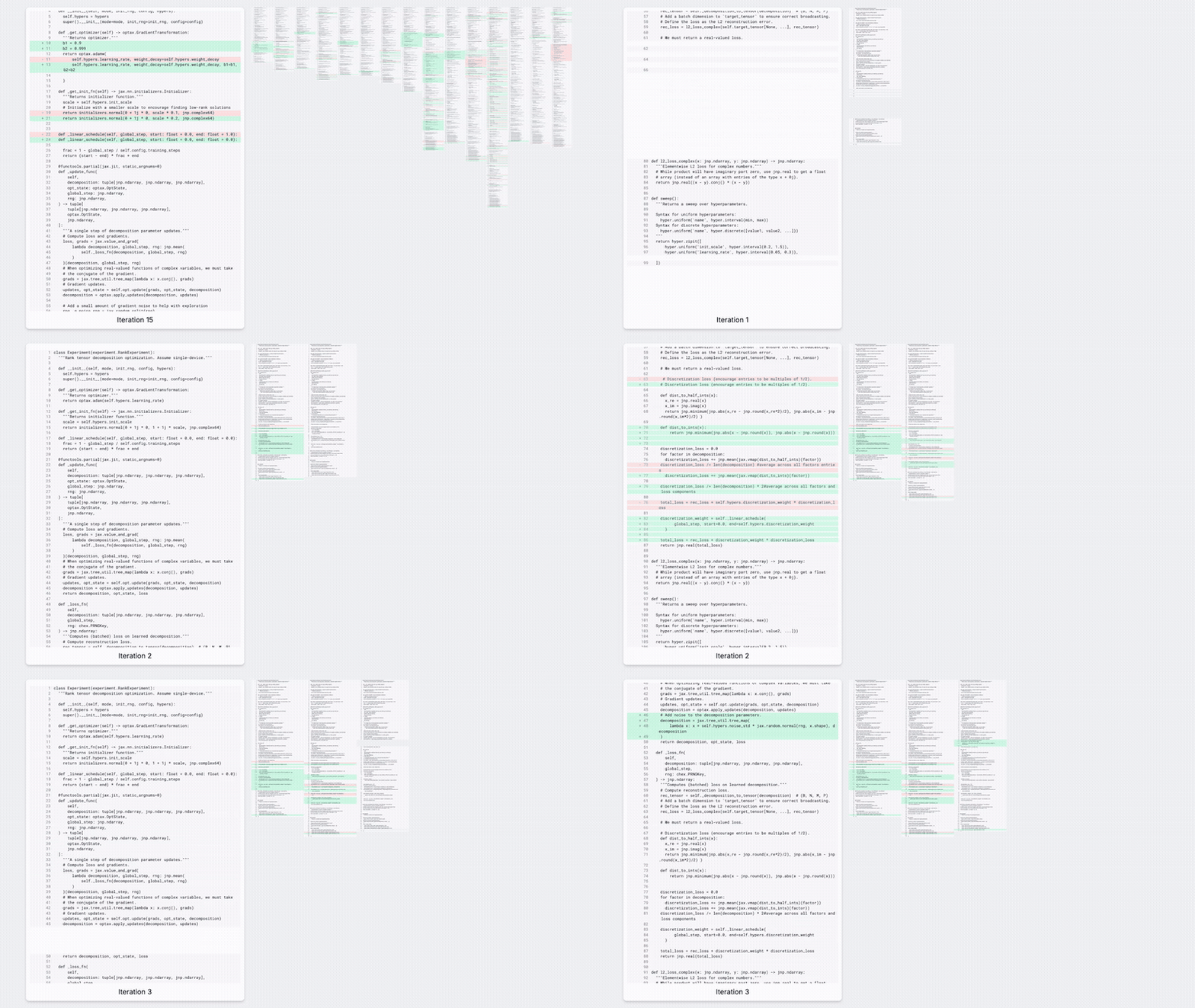
Source: DeepMind’s Alpha Evolve at Work
That Haut-Katanga pilot isn’t real (yet), but it’s getting pretty plausible.
AlphaEvolve already runs a version of that loop. It generates its own ideas, evaluates them and builds on the strongest. It improved on long-standing results in 20% of cases it examined.
Robin, an AI system developed for biomedical research, goes further: it searches scientific literature, proposes experiments, analyses results, and decides what to investigate next. Working alongside human researchers, it identified a candidate treatment for macular degeneration that no previous study had proposed.
Neither of these is a bioremediation lab in the DRC. But they're early demonstrations of the same underlying shift, from AI that executes a plan someone else designed, to AI that proposes what to try next and learns from what happens.
The chapter we’re in right now is AI + X (a timely reflection given the new AI Minister’s recent announcement - the country that brought you fish and chips is now bringing you drones and chips). Beyond AI + X, we could see systems that can discover solutions nobody had thought to try. The autonomous lab in Haut-Katanga is one version of what that could look like.
We've written up what we found in two pieces. The first explores the shifts we’re seeing. The second asks what’s worth testing, given those signals.
Join us on a Field Trip to the Future
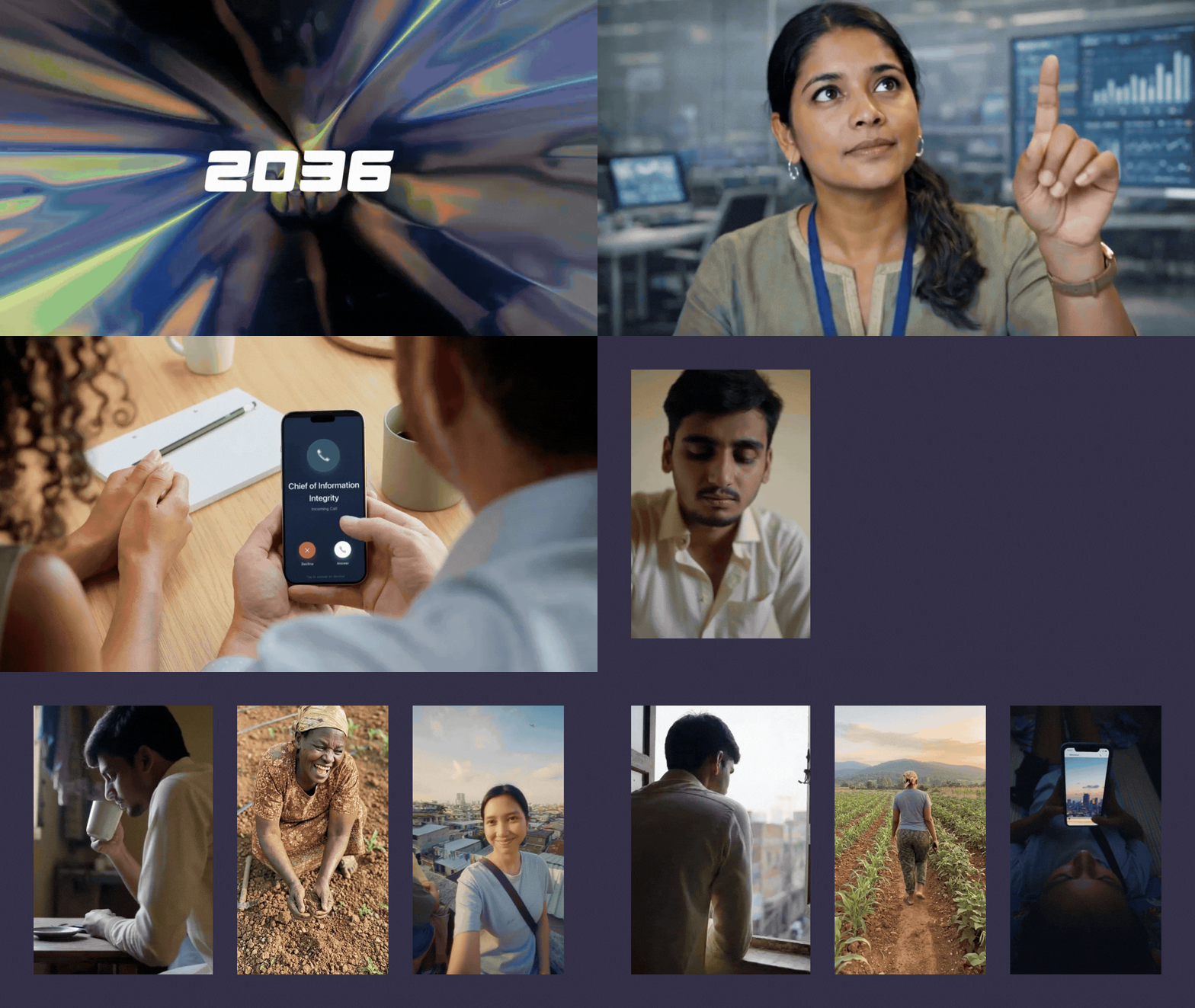
We’ve been running field trips to the future for teams around the world, and for the first time ever we want to take you with us. Once there, you'll meet fictional people living and working in that future, through AI-generated dispatches from the field. Their experiences will be grounded in the real signals we’re tracking today.
Together, we will explore how emerging AI capabilities might change international development. We’ll then work backwards from their experiences to ask what that future requires from the sector now.
This invitation is our way of saying thank you for being a member of the FT Network and helping to grow this community. Given the turbulent sector we all exist in, we need spaces like this (right here, now) to convene, imagine and cultivate new solutions more than ever.
Expect a truly immersive, interactive experience (from the comfort of your own keyboard).
Where this leaves us
We’ve covered a lot over the last four issues.
In Issue 1, we argued that across a decade of AI pilots in low-resource settings, the breakthrough was rarely the algorithm. It was the quality of the data, whether the infrastructure could carry it, and whether the people who needed it most were in the picture at all.
In Issue 2, we argued that the most important responsible-AI decisions almost never arrive labelled as such. They show up as technical pivots, feasibility constraints, parameter adjustments. If nobody writes them down as the ethical choices they are, the next team has to rediscover them by luck.
In Issue 3, we argued that the sector is in danger of making the same mistake with AI that it made with mHealth: building 80 things that can't talk to each other, until someone shuts the lot down. The alternative is shaping a new default: when you build something useful, share it.
And in this issue, the future we’re hurtling towards, where AI becomes part of the systems that shape decisions, organise resources, and discover solutions. Whether that arrives as empowerment or extraction depends less on the models than on the choices the sector makes now: about what to build, what to share, and who gets to decide.
The hard part was never the technology. It was the data, the institutions, the decisions nobody logged, the norms around sharing, and who gets to sit in the room when the important calls get made. It’s been true for the last ten years, and it will be for the next ten.
If you found this AI mini-series useful, insightful, or even somewhat entertaining, it would mean the world to us if you shared it with a colleague ⚡️
And as ever, we would love to hear your thoughts, reflections and ideas, so please do let us know what’s on your mind.
In other news
This is where we share recommendations from members. Our Network is all about collective insight, so if you’ve come across something worth sharing, get in touch!
For anyone interested in the intersection of AI with the art and science of learning, check out Dr Phil’s newsletter. We enjoyed her article about what she learned from watching 100+ practitioners use AI in their day-to-day work, so start there.
In 2023, we explored how AI is changing diplomacy with FCDO staff, looking 10 years into possible futures.
The UK Government Office for Science published its updated set of AI scenarios for 2030. The five scenarios all agree on one thing with striking consistency: the favourable outcomes are not the default.
And finally, another book recommendation from the Network - ‘Digital Inclusion in an Unequal World: An Emancipatory Overview’ by Tim Unwin, who describes it for “all those who want to ensure that the world’s poorest and most marginalised people and communities can benefit from the use of digital technologies, rather than being further marginalised and enslaved through them.”
If you’d like to dig in further…
✉️ Explore our other newsletter issues
⏩ Read the first issue in this series
🔈 Join the FT Network to receive the newsletter directly to your inbox (alongside an audio version)