A blog by GDI Hub introducing a playbook on what inclusive mobility can achieve when it is designed with the people it serves
Kenya’s unmet wheelchair need exceeds 95,000 units annually. Globally, more than 80 million people need a wheelchair they cannot access (WHO, 2023), and in low-and middle-income countries access to assistive technology can be as low as 3 to 5 per cent (WHO and UNICEF, 2022).
The Electric Mobility Pilot playbook makes the case that this is a large, underserved market with a working model.
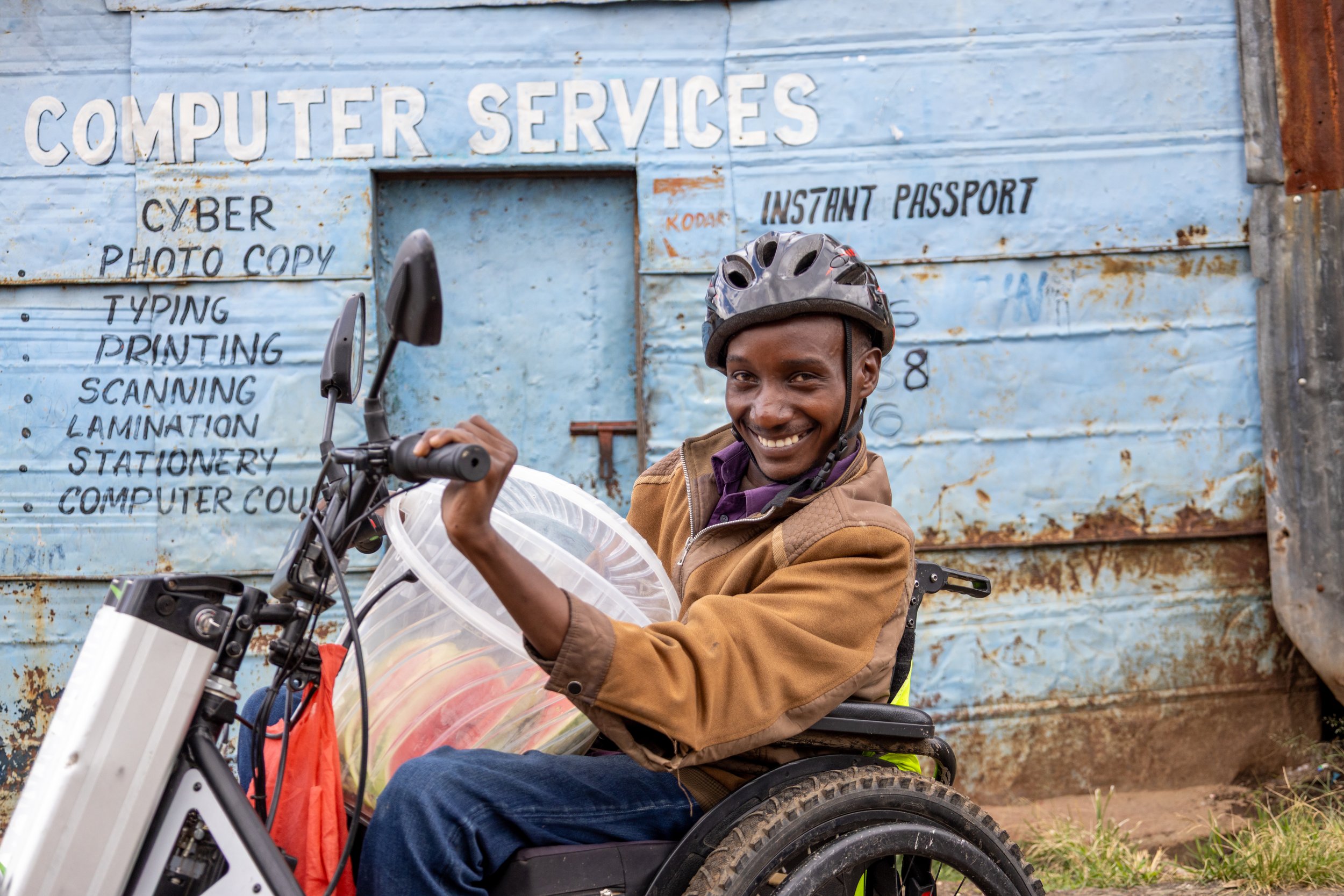
Photo by Harrison Kamau, GDI Hub
GDI Hub and Frontier Tech Hub are excited to publish the Electric Mobility Pilot playbook, the culmination of a three-year pilot funded by UK International Development through the Global Research and Technology Development portfolio. The pilot brought together a consortium including MATT (Colombia), NeoMotion (India), Kounkuey Design Initiative (Kenya), Ebikes Africa (Kenya) with Jionee Self Help Group as community partner in Nairobi. The pilot builds on evidence from the AT2030 programme.
The research was largely undertaken in Korogocho, one of Nairobi’s largest informal settlements. The wheelchair users there gave a nickname to the electric third-wheel attachments they had been testing: ndege, the Kiswahili word for aeroplane. Because of its speed and also what movement made possible.
The pilot set out to explore whether electric third-wheel attachments (powered devices that convert a manual wheelchair into a three-wheel electric trike) could work in Kenya’s informal urban settlements. The technology had been proven in India and Colombia. Whether it could transfer to Nairobi was an open question, and the questions that followed were technical. Could the technology transfer? Would the terrain allow it? Would people adopt it?
The playbook documents what was built, learned, and what it would take to do it again. It shows that community-owned hubs are able to provide daily access to powered mobility devices, which can then generate real income for wheelchair users in the community. It shows that local manufacturing and assembly can reduce costs substantially and strengthen the local economy. And it shows that when mobility is unlocked, the economic, social and civic changes that follow are measurable and sustainable.
Explore Frontier Tech pilots leveraging clean technology



If you’d like to dig in further…
🔘 Find out more about GDI Hub
🔘 Read our report on piloting and scaling e-mobility solutions