Nairobi 2045: a field trip to the future

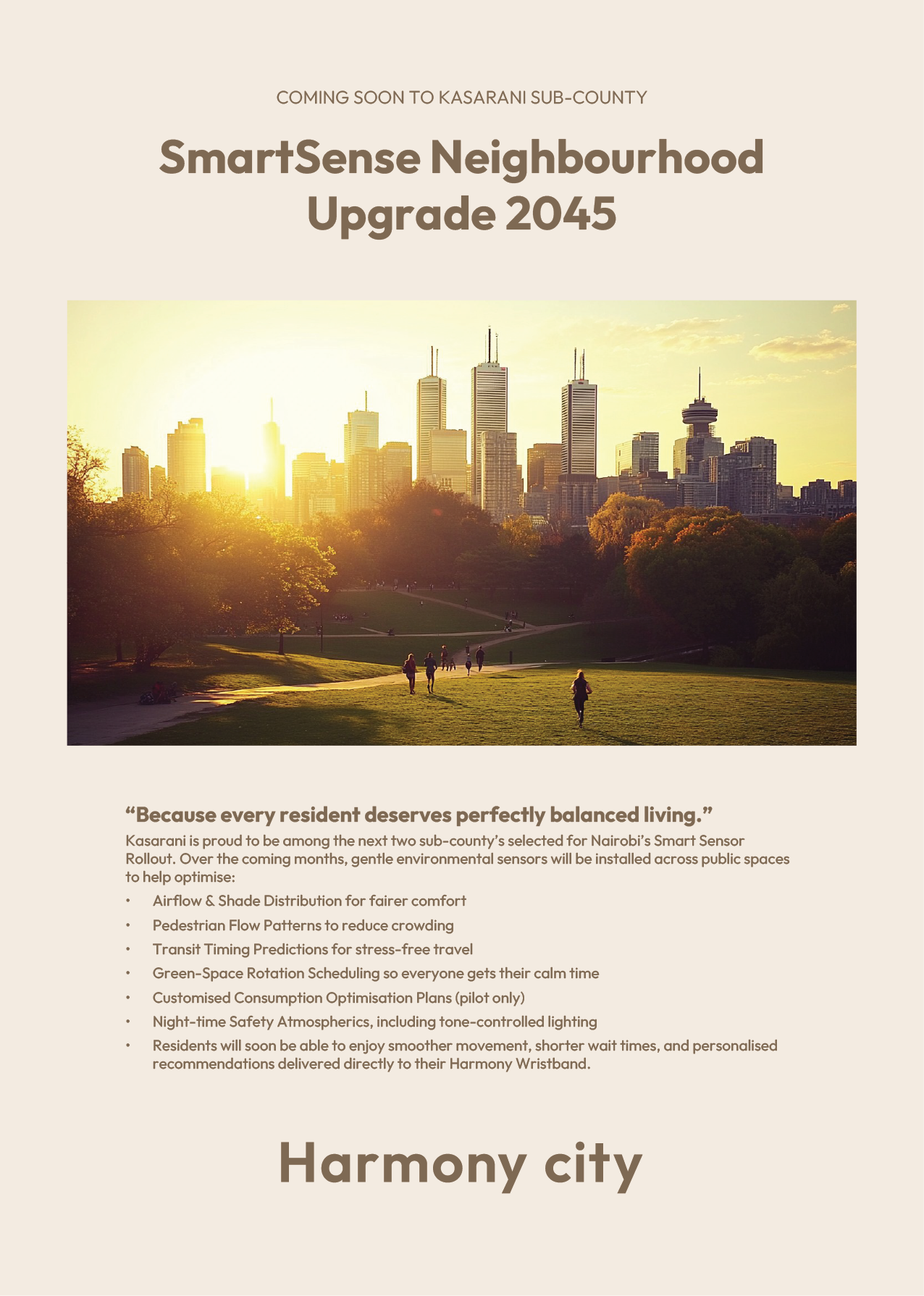
In Harmony City, Amina walks through public spaces that feel meticulously orchestrated, and the city centre has become the most transformed district of all. Now, green spaces thread through the Central Business District, lush and accessible, but every patch is regulated by the City Council to ensure that millions of Nairobi residents can enjoy them in carefully timed cycles.
Amina moves through this system with quiet resistance. She is neurodiverse, and while others celebrate the calm predictability of AI-managed nature, she often experiences it as overbearing. Her defiance is subtle but visible. She wears loud, colourful clothes that match her emotions and makes her interior life public in a way the city cannot fully process. In a city that encourages uniformity of movement and mood, and where wristbands direct people through public space, her clothing refuses to flatten itself into harmony.
Today she is heading to Uhuru Park, the largest of the transformed green spaces and the most heavily optimised. Drones trim canopies into graceful arcs, paths curve toward areas with lower density, and benches gently signal when your rest period is ending. People rarely linger beyond their allotted time because they are behaviourally ‘nudged’ to leave the space for others. The park is spacious and beautiful, but it behaves with the discipline of a public utility.
Amina is meeting her friends from the glitch collective - artists and everyday rebels who crave moments the algorithms can’t choreograph. They’ve been quietly reclaiming small pockets of the city centre, inserting unpredictability into the flow: ephemeral digital graffiti on public walls, unpredictable behaviours which confound surveillance and city-sensors, and micro-performances in public space that the City Council takes a moment too long to interpret.
Today’s plan is a flash mob in Uhuru Park. Nothing noisy. Nothing disruptive in the traditional sense. A hundred people standing completely still, silent. In a space governed by circulation models, a collective pause becomes a small rupture.
As Amina enters the park, the collective is already forming, motionless among the park’s choreographed pathways. The City Council attempts to compensate, rerouting foot traffic, adjusting dwell-time reminders, trying to fold the stillness into its logic. But for a few minutes, the centre of Harmony City hesitates.
Amina steps into the stillness, and her clothes flare with a quiet shimmer. In a world optimised for constant gentle movement, she chooses not to move at all.
Consider the following questions about Harmony City:
What pathways led to this city? What key trends, shocks, or policy choices over the past 20 years most likely produced this highly optimised urban environment?
What trade-offs are embedded in this future? What has been gained through optimisation and behavioural management and what may have been constrained or lost as a result?
Why do people accept - or choose - this city? What makes a tightly choreographed urban system attractive or tolerable for its residents, despite the limits it places on behaviour and expression?
Which innovations or policies thrive in a highly optimised city - and which forms of creativity, experimentation, or bottom-up innovation struggle to take root?
You’ve chosen Harmony City. This is one of three Urban Futures scenarios exploring how Nairobi could evolve by 2045 - Click below to choose another scenario.