

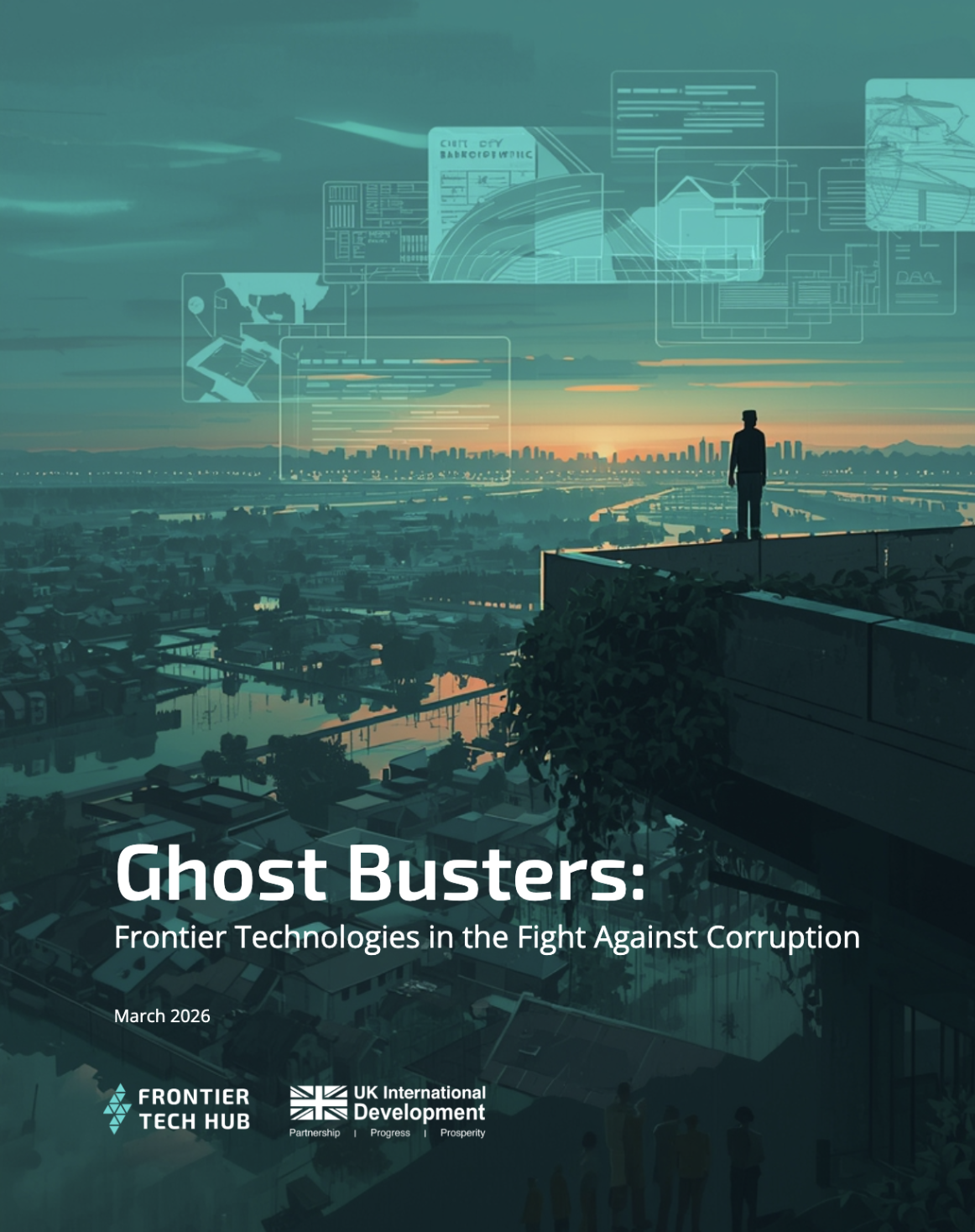
Ghost Busters
Frontier Technologies in the Fight Against Corruption

Billions spent. Nothing built.
In the Philippines, over 400 "ghost projects" have been uncovered in flood-control infrastructure alone. Billions of pesos were disbursed. Many communities received nothing. This is theft of public money, of physical protection, and of the trust that functional government depends on.
Across Asia, Latin America, and beyond, governments and civil society are deploying AI, satellite imagery, open data platforms, and citizen reporting tools to detect irregularities, track project delivery, and build evidence for prosecution. Results are uneven, and context matters, but the direction of travel is clear.
If UK government bodies, businesses, and investors are to engage seriously with Philippine markets, they need confidence that public institutions work and that contracts mean what they say.
Through research and horizon scanning, FT Hub and partners have explored the tech vs corruption landscape. Our report profiles 6 international case studies, 8 technologies, and 5 trends.
The anti-corruption chain
Corruption in public infrastructure doesn't happen in one place. It happens at multiple points along a chain, from the moment a project is specified through to the moment funds are released for work that may never have been done. The technologies described in this paper each address different points in that chain.

What the tech can actually do
Before asking where the field is heading, it's worth understanding the technology families at work. What each one can reliably do today, where its limits are, and where it's heading over the next five years.
-
Finds suspicious patterns in large procurement datasets that human auditors can't feasibly review. Flags unusual specifications, improbable win rates, and systematic contract amendment patterns. Used for triage, not automated judgement.
In five years
LLMs will read the actual text of tender specifications and assess whether requirements appear designed to exclude competition. Unsupervised anomaly detection will work even where historical corruption cases are rare or suppressed.
-
The only technology that can independently verify physical reality without human presence. Confirms whether a project was actually built, in the right location, at approximately the right scale. Can't easily verify whether it meets contractual specifications.
In five years
Falling imagery costs, improved computer vision, and multi-sensor integration (LiDAR, multispectral) could enable remote assessment of approximate dimensions, material consistency, and structural integrity from orbit.
-
Every analytical tool in this space depends on it. Standardised, machine-readable procurement data is the prerequisite. The persistent gap is between mandate and reality: passing a law and having clean, timely data published are different things.
In five years
The shift from open procurement data to linked open government data, connecting procurement records to company registries, beneficial ownership databases, asset declarations, and budget execution systems, creates detection possibilities impossible with procurement data alone.
-
Maps connections between companies, individuals, government bodies, and contracts to reveal conflict-of-interest structures invisible in transaction-level data. Requires clean entity identifiers. Network proximity is not proof of corruption, and systems need strong due process safeguards.
In five years
Integration of beneficial ownership data and LLM extraction of relationship data from unstructured sources (news, court records) could flag, in near real time, any tender where a bidder's beneficial owner has a documentable relationship with an evaluating official.
-
Distributes detection capability across a population that no government institution can match for scale or local knowledge. Citizens can interrogate procurement data, flag incomplete projects, and submit evidence. The persistent limit is sustainability: civic tech is frequently under-resourced and politically vulnerable.
In five years
AI-assisted tools in local languages, integrated with satellite verification, could create a powerful pipeline: a citizen flags a stalled project, imagery confirms no construction activity, and the combined evidence package is automatically routed to an oversight body.
-
Creates tamper-evident, append-only records. Its honest current use is narrow: preventing retroactive record manipulation. Most procurement corruption doesn't depend on altering records after the fact, it depends on making the right decisions before the record is created.
In five years
Most defensible role is likely as an integrity layer for specific high-value, high-risk transactions such as donor-funded projects, and for tracking physical supply chains to confirm that materials purchased were actually delivered to site.

What has been tried internationally?
Six cases, drawn from a wider international review. Different technologies, different contexts, different parts of the world. What they share is evidence about what conditions make the difference between a tool that works and one that doesn't.


Five directions of travel
So where is this heading? Here are five trends or directions already visible in pilots, deployments, and research. This is where anti-corruption technology is heading in the Philippines and beyond over the next five years.
-
The traditional anti-corruption model is retrospective: something goes wrong, evidence accumulates, an investigation begins. The emerging model intervenes before a corrupt decision is finalised. Systems are being designed to flag irregularities while a tender is still live, alert officials before a contract is signed, and create friction at the moment corruption is most stoppable.
Paraguay's procurement authority issues real-time alerts inside its e-procurement platform, mapped to specific legal violations, at the exact decision points where officials can still act. Brazil's ALICE system has moved from periodic audit to daily automated screening of hundreds of thousands of processes. The Dominican Republic has linked red-flag monitoring directly to supplier debarment, closing the loop between detection and consequence.
-
For decades, anti-corruption efforts focused on the moment of award. But ghost projects don't fail at the tender stage, they fail at delivery. The frontier has shifted to tracking a project from pipeline stage through physical construction, and eventually tying verified delivery directly to payment release. When every stage of a project leaves a digital trail, ghost infrastructure becomes structurally harder to sustain.
Ukraine's DREAM platform tracks over 12,000 reconstruction projects end-to-end across 87% of local governments. The World Bank's GEMS initiative has deployed GPS, photo verification, and satellite imagery across 1,000+ projects in 100+ countries. Satellite-based ML models are being tested to assess road quality over time from orbit, enabling auditors to cross-check contractor progress claims without setting foot on site.
-
The most resilient anti-corruption systems in this review share a design principle: they don't rely on government alone to police government. The pattern that works is hybrid: state-managed data infrastructure that is open by default, combined with independently-operated monitoring by civil society, journalists, and citizens. Neither alone is sufficient. Governments can suppress or defund official tools when politically inconvenient. Civil society can't act without access to the underlying data.
In the Philippines, BetterGov.ph volunteers have already connected PhilGEPS, DIME, budget, flood control, and political dynasty data into a publicly accessible analytical platform. Bisto.ph has secured a formal DPWH partnership for citizen ground-level inspection of 250,000 infrastructure projects nationwide. The architecture that works is the one where data is legally mandated to be public, and the monitoring layer is structurally independent.
-
Until recently, building a procurement risk analytics system required significant custom development. That constraint is dissolving. New open-source infrastructure means the capability to run red-flag analytics, network analysis, and risk scoring is increasingly available off the shelf. The binding constraint is no longer "can we build this?" It's "do we have clean enough data, sufficient institutional will, and a credible enforcement hook at the end?"
The Open Contracting Partnership's Cardinal library automates red-flag calculation for any government publishing data in the open contracting standard, deployable by a civil society organisation without major technical investment. In the Philippines, the 2024 New Government Procurement Act has created the open contracting data mandate that makes this possible.
-
Most tools in this landscape stop at the same point: a flag, a dashboard, an alert. The emerging frontier is systems designed not just to detect risk but to package evidence for enforcement, building the chain from algorithmic signal to prosecutorial action. This is the least developed part of the landscape, and the most consequential.
Kazakhstan's redflags.ai routes procurement anomaly alerts directly to prosecutors. The World Bank's GRAS deployment in Brazil surfaced over 850 suppliers showing signs of collusion, 450 likely strawmen, and 500 cases of companies owned by public servants receiving contracts from their own agencies. BetterGov.ph has built a political dynasty mapping tool cross-referencing procurement awards against family networks across 82 Philippine provinces.
Read the report in full
This page covers the highlights. The full paper includes detailed case write-ups, a complete technology landscape assessment, methodology notes, scoring across eight dimensions of Philippine fit, and exposes the 5 trends to adversarial critique from 3 AI-generated personas. Fill in the form to download it.
Project Team
-

Dr Sam Stockley-Patel
Research & Engagement Manager, Frontier Tech Hub
-

David Vigoureux
Futures Lead,
Frontier Tech Hub -

Kristine Borja
Head of Politics and Governance, FCDO Philippines
-

Noelle Agudelo
Policy Advisor,
FCDO Philippines -

Vince Guina
Political Support Officer,
FCDO Philippines -

Karl Satinitigan
Systems and Policy Design,
Frontier Tech Hub